
Millions of people download every year apps to check moles in the hope that their cell phone will tell them if a mole is dangerous. In the Netherlands, 2.2 million adults received free access to one of these apps through their insurer. [(Hajian et al., 2023)].. The question I am constantly asked in my practice is clear: do they really work?
The short answer, as of today, is that they can help you be more attentive, but they can't diagnose you. And the difference between the two is huge when we're talking about malignant moles or melanoma.
My name is Sebastian Podlipnik and I am Dermatologist at the Melanoma and Skin Cancer Unit of Hospital Clínic de Barcelona. In addition to treating patients, I actively research in artificial intelligence applied to dermatology. I have participated in the evaluation of 129 AI algorithms for the diagnosis of skin lesions. [(Combalia et al., 2022)]. and I am co-author of the EADV (European Academy of Dermatology) position statement on AI apps. [(Sangers, Podlipnik et al., 2023)]. This experience allows me to tell you, with data, what these apps can and cannot do.

What are mole checking apps and how do they work?
The apps to check moles are mobile applications that analyze photographs of skin lesions to estimate whether they may be benign or suspicious. They work through algorithms of artificial intelligence, specifically convolutional neural networks (CNNs), trained on thousands of lesion images classified by dermatologists.
The process is simple: you take a photo of a mole with your cell phone camera, the app processes it through its algorithm and returns a risk rating (generally low, medium or high). Some apps add photo-tracking functions so that you can compare how a mole evolves over time.
Adoption of these tools has grown dramatically in recent years. In the Netherlands, one insurer offered free access to SkinVision to 2.2 million adults, making it the first population-scale app-based screening program in the world [(Hajian et al., 2023)].. Meanwhile, the European Academy of Dermatology (EADV) published a position statement in 2023 alerting to the need for transparency, equity between patient groups and a more rigorous European regulatory framework for these applications. [(Sangers, Podlipnik et al., 2023)]. Just because millions of people use them does not mean that they are ready to replace a professional consultation.
- Convolutional Neural Network (CNN)
- Type of artificial intelligence specialized in analyzing images. It learns to recognize visual patterns (edges, colors, textures) from thousands of labeled examples. It is the technology used by most mole analysis apps.
There are three main categories of mole-related apps, and it is important not to confuse them:
- Apps with AI analysis: automatically analyze the photo and give you a risk assessment (SkinVision, Skinive). These are the most promising, but also the ones that generate the most debate.
- Photo tracking apps: allow you to photograph your moles periodically and compare changes, without issuing any automatic diagnosis (Miiskin, MoleMapper). They are registration tools, not analysis tools.
- Teledermatology Apps: send your photos to a real dermatologist who evaluates them remotely (some FotoSkin functions). Here an algorithm does not decide, a doctor decides.
The best apps to check moles in 2026
As of March 2026, these are the following apps to check moles most widely used and supported, sorted by type of functionality. None of them replaces a dermatological consultation, but some have more scientific evidence than others.
| App | Type | CE Marking | Published studies | Cost |
|---|---|---|---|---|
| SkinVision | AI + tracking | Yes | Multiple (BMJ, Cancers, NPJ) | ~30-50 EUR/year |
| FotoSkin | Follow-up + teledermatology | No | Developed with AEDV | Free |
| Scanoma | IA | No | Limited | Free with premium |
| Skinive | IA | Yes | Some | Free with limits |
| Miiskin | Photographic follow-up | Not applicable | Limited | Free with premium |
Of all of them, SkinVision is the one with the most published scientific studies, although this does not mean that its results are infallible. FotoSkin has the backing of the Spanish Academy of Dermatology (AEDV), which gives it institutional credibility in our country. Miiskin, on the other hand, does not claim to diagnose anything: it simply helps you keep a photographic record of your moles, something we value positively in our practice.
Are mole checking apps reliable? What the scientific evidence says
The reliability of the apps to detect melanoma varies greatly depending on the study and the conditions under which they are evaluated. In controlled settings, the best algorithms achieve a sensitivity of 87% (comparable to expert dermatologists). In actual practice, the numbers drop significantly. [(Salinas et al., 2024)]..
A systematic review published in the BMJ evaluated CE-marked smartphone apps available to consumers. The results were concerning: SkinVision showed a sensitivity of 80% (CI 95%: 63-92%) and a specificity of 78% (67-87%) for malignant or premalignant lesions. Another app evaluated, SkinScan, had a sensitivity of 0%, i.e., it did not detect any malignant cases. The authors concluded that the available studies were of low methodological quality and that the CE mark did not guarantee adequate protection to the public. [(Freeman et al., 2020)]..
A subsequent study specifically analyzed SkinVision's overdetection compared to dermatologists. The app classified as suspicious many lesions that were benign, generating unnecessary anxiety. Only 8.8% of participating dermatologists considered the app reliable for clinical evaluation. [(Jahn et al., 2022)]..
Fortunately, it's not all bad news. A prospective trial in 36 primary care centers in Sweden showed that an AI tool to support general practitioners achieved a sensitivity of 95.2% and detected 100% of invasive melanomas. [(Papachristou et al., 2024)].. The key difference is that in that study the AI was assisting a physician, not replacing his or her judgment.
App vs dermatologist: what each can do
An app analyzes a single photo of an isolated lesion. A dermatologist evaluates your entire skin, your medical history, your risk factors, and uses professional tools such as the digital dermoscopy with 10-20x magnification optics and polarized light. The difference is not only in precision, but also in clinical context.
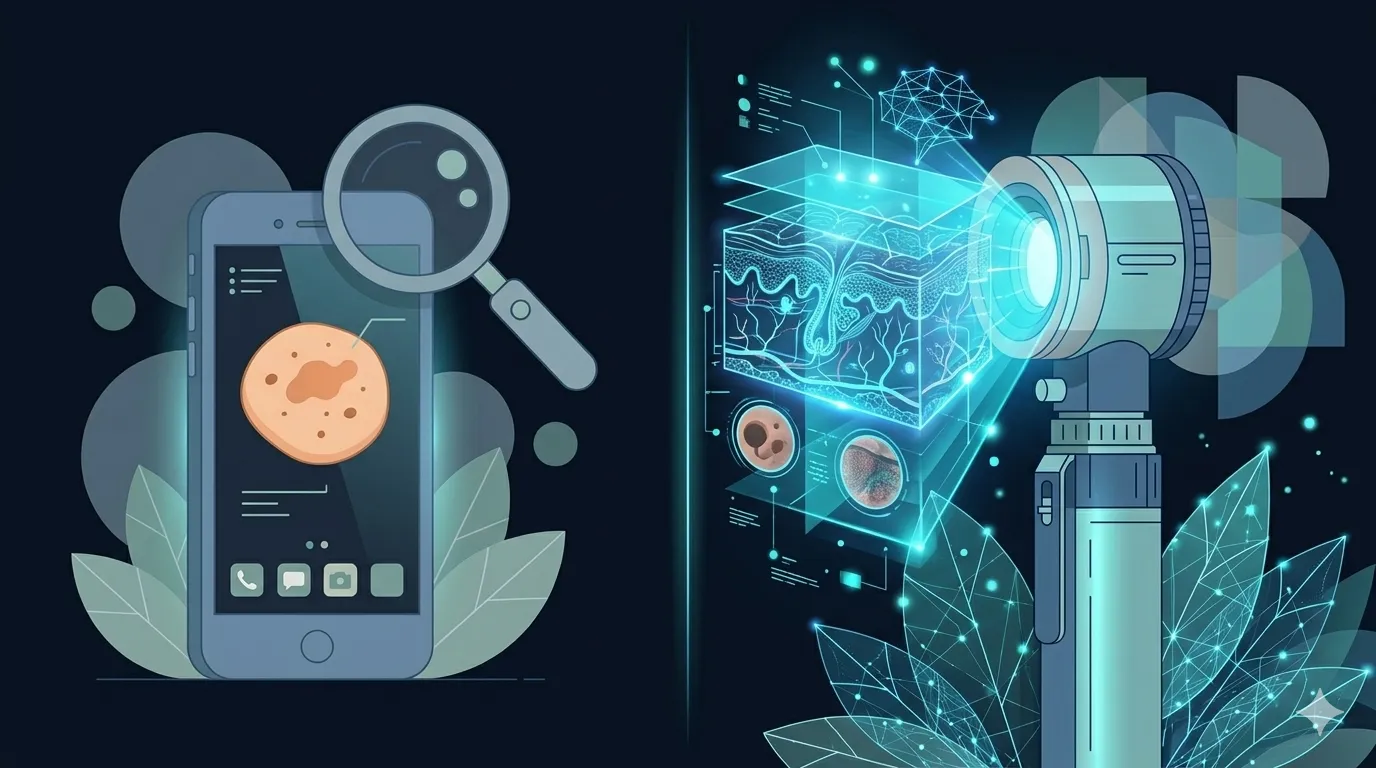
A meta-analysis of 53 studies directly compared the performance of AI with that of different practitioners. Algorithms achieved a sensitivity of 87.0% and a specificity of 77.1%. Expert dermatologists obtained similar figures (86.3% and 84.2% respectively). However, AI clearly outperformed general practitioners. [(Salinas et al., 2024)].. This suggests that the greatest potential of these tools lies in assisting non-specialist physicians, not in replacing the dermatologist.
"An app can be a good first filter, but diagnosing a mole requires clinical context that no algorithm can capture through a cell phone photo. As of today, technology complements, not replaces."
Dr. Sebastian Podlipnik
What I learned from researching AI applied to melanoma
In my work as a researcher I have participated in projects that are directly behind the technology that these apps use. That gives me a perspective that you will hardly find in a "top 5 apps" list. Here are three things I've learned that I think you should know.

Algorithms work great in the lab, but not so well in real life
In the 2019 ISIC Grand Challenge, we evaluated 129 AI algorithms with images from the Hospital Clínic de Barcelona (our BCN20000 dataset, with 18,946 dermatoscopic images). The best algorithm achieved 82% accuracy with controlled images, but dropped to 58.8% when faced with clinically realistic images. In addition, 47.1% of the images that did not fit the training categories were misclassified as malignant [(Combalia et al., 2022)].. This has direct consequences: unnecessary biopsies and anxiety in patients.
58.8%
Best AI algorithm accuracy with clinically realistic images, vs. 82% achieved with controlled lab data
AI transparency is key to making it work in practice
Together with my team, we published a relevant finding in Nature Communications: when an algorithm explains why it classifies a lesion as suspicious (by pointing out the structures that catch its attention, similar to the way a dermatologist reasons), the physician's confidence in the tool increases significantly. [(Chanda, Podlipnik et al., 2024)].. Current consumer apps do not offer this transparency: they give you a traffic light (green, yellow, red) without explaining what they have seen.
The data on which you train set the limits
Something that particularly concerns me: our BCN20000 dataset contains images taken with professional dermatoscopes in a reference hospital. [(Hernández-Pérez, Podlipnik et al., 2024)].. Most training datasets contain images of people with fair skin (phototypes I-III). This means that the algorithms may perform worse on people with dark skin (phototypes IV-VI), precisely a group where acral melanoma in areas such as palms and soles can be more difficult to detect.
Are you worried about a mole?
I can help you. Choose the option that best suits you.
When to use an app and when to go to a dermatologist?
Apps can be a useful complement to self-monitoring of your skin, but they should not delay a consultation when there are warning signs. Here is a practical guide based on my clinical experience and the EADV recommendations. [(Sangers, Podlipnik et al., 2023)].
When an app can be useful to you:
- Photographic follow-up: to keep a visual record of your new or existing moles and detect changes over time.
- Awareness: if you have never looked at your moles, an app can motivate you to start doing so.
- First information filter: to decide whether it is worthwhile to make an appointment, without replacing the consultation.
⚠ Consult your dermatologist if you observe.
- A mole that grows, changes color, shape, or texture over weeks or months
- A mole that itches, bleeds or crusts for no apparent reason
- ABCDE Rule: Asymmetry, Irregular edges, Heterogeneous color, Diameter larger than 6 mm, Recent evolution
- Personal or family history of skin cancer or melanoma
- Dark skin (phototypes IV-VI): algorithms are mostly trained on light skin and have more limitations.
AI is advancing rapidly and it is likely that in the next few years these tools will improve substantially. But today, based on the available evidence, an app is not a substitute for an appraisal of a specialized dermatologist. Early detection of skin cancer still depends on a combination of informed self-monitoring and professional screening.
Frequently asked questions about mole checking apps
Is SkinVision reliable in detecting melanoma?
SkinVision is the app with the most published studies, but its reliability varies: sensitivity ranges from 41% to 83% depending on the study and evaluation conditions. [(Jahn et al., 2022)].. It can be useful as a supplemental tool to be more aware of changes in your moles, but should not be relied upon as the sole method of detection. If you have a mole that concerns you, consult a dermatologist.
Can a mobile app detect skin cancer?
To date, no app can diagnose skin cancer reliably enough to replace a professional. The best algorithms achieve 87% sensitivity in laboratory conditions, but in actual practice performance drops significantly. [(Combalia et al., 2022)].. Apps can provide guidance, but definitive diagnosis requires dermoscopy and, in many cases, biopsy.
Do mole apps work on dark skin?
Most AI algorithms have been trained predominantly with images of light skin (phototypes I-III). A review of 19 studies comparing neural networks with dermatologists confirmed that almost all were performed under artificial conditions, without representing the actual diversity of patients [(Haggenmüller, Podlipnik et al., 2021)].. This means that its performance is lower in people with darker skin. If you have a high phototype (IV-VI), it is especially important that you do not rely exclusively on an app and that you have regular dermatological check-ups, paying attention to areas such as the palms of your hands and soles of your feet.
What is the difference between an app and digital dermoscopy?
Digital dermoscopy uses professional optics with 10-20x magnification and polarized light, making it possible to visualize internal structures of the mole that are invisible to the naked eye. The apps use the standard cell phone camera, without magnification or specialized lighting. The difference in resolution and diagnostic capability is enormous. They are tools that operate in completely different categories.
How much do mole checking apps cost?
Prices vary according to the app and the business model. SkinVision works on an annual subscription basis (between 30 and 50 euros approximately). FotoSkin is free and is endorsed by the AEDV. Scanoma and Skinive have free versions with limited features and premium options. Photo-tracking apps such as Miiskin usually have free basic versions.
Consultation with a specialist dermatologist
Mole-checking apps are an example of how technology can bring us closer to prevention. But in March 2026, the scientific evidence is clear: they complement, not replace. If a mole concerns you, if it has changed, or if you simply want a complete check of your skin, the best decision is to consult with a professional who can assess the full context.
Do you want a professional assessment?
I can help you. Choose the option that best suits you.



 Spanish
  English