
The appearance of new moles on our skin is a very frequent and normal phenomenon.. The technical name of a mole is nevus and comes from Latin meaning birthmark, however most of them appear in adolescence and adulthood. But not all new lesions that appear on our skin are moles and it is important to know the differences and the most frequent causes.
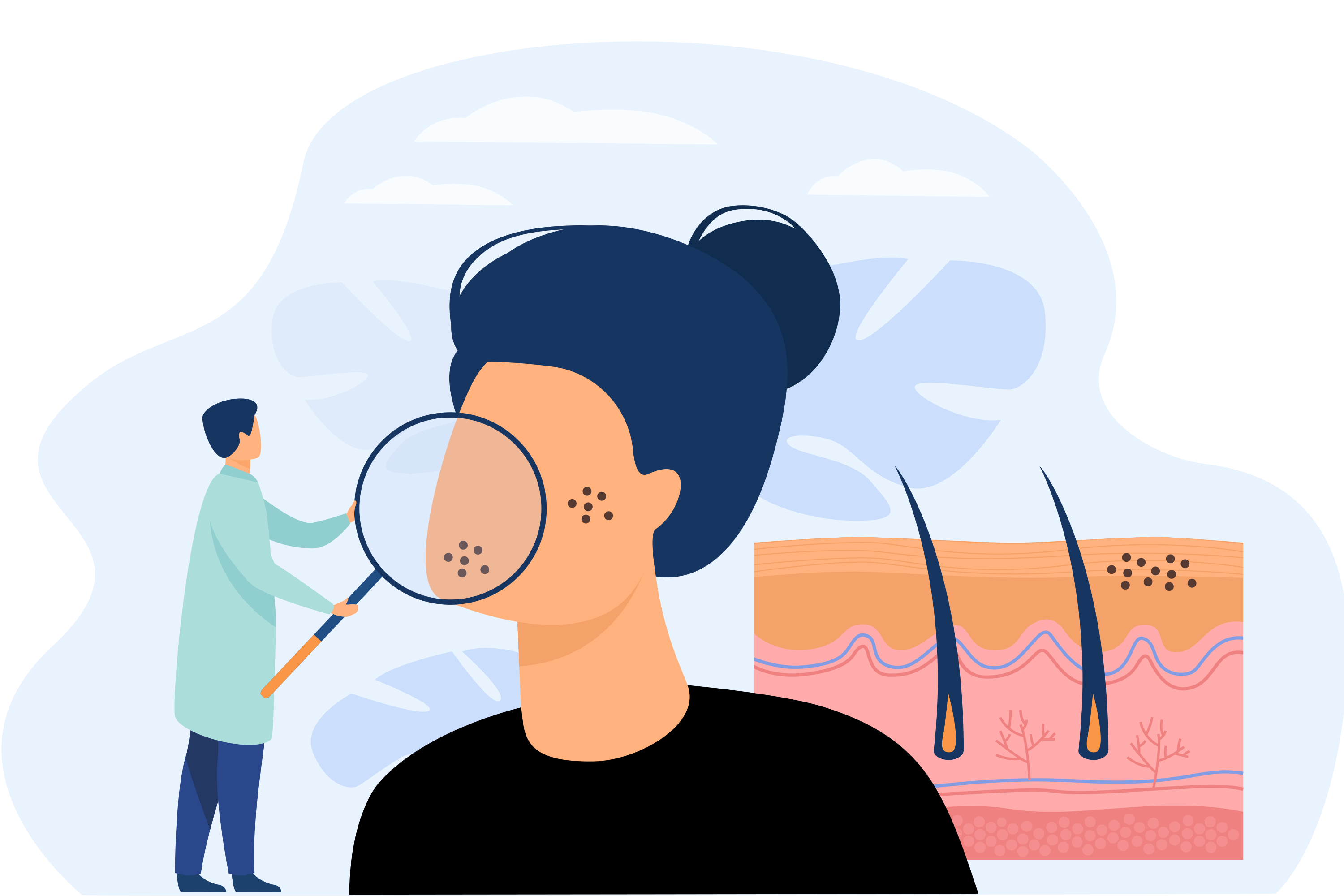
So, are all new skin lesions moles?
No, not all the spots that appear on the skin are moles. In my practice I see many, many types of skin lesions that look very similar to moles, but after examining them in detail I make a different diagnosis.
Among the most frequent diagnoses that I see in my office when my patients ask me about the appearance of new moles are:
- Benign solar lentigines
- Seborrheic keratoses
- Fibromas or acrochordons
- red polka dots
- Melanocytic nevus

In this informative infographic I show you the most common causes of new skin lesions grouped by age. But in reality there are many more causes that only dermatologists are qualified to evaluate them.
How to establish the diagnosis of new moles?

Every time I see a patient with a new mole, I explain the importance of a proper diagnosis. To this end, dermatologists we use dermoscopy to make more accurate diagnoses.
Therefore, when new moles appear on the skin, a visit to your favorite dermatologist is always recommended.
1- Melanocytic moles or nevus
The appearance of melanocytic moles is a very frequent phenomenon during adolescence and young adulthood. Nevi are proliferations of melanocytes, which are the cells responsible for coloring our skin. Normally we differentiate moles into 2 types depending on the depth they are located in our skin.
- Joint nevus: correspond to flat moles and are usually light brown to black in color. They are benign and remain stable over time.
- Dermal nevusDermal or warty moles (because of their shape), on the other hand, are those that have relief. They are also known as flesh moles. These moles tend to protrude over time and lose their pigment.
- Other melanocytic nevi: there are many more types of moles. If you are interested in knowing them what types of melanocytic nevus exist you can see them here.
Joint nevus

Dermal nevus

Why do I get new moles?
Different studies have shown that in most cases it is an interaction of multiple genetic factors associated with sun exposure that triggers the appearance of the same. Lhe good news is that almost all moles are benign.
On the contrary, if new moles appear in an adult, they are more likely to become cancerous than those we have had all our lives. If you have new moles after the age of 40 it could be a malignant skin lesion.
Is it normal if I have many new moles?
Having some moles on our body is perfectly normal. But if we have lots and lots of moles and some of them have atypical characteristics, you may have a increased risk of developing melanoma during your lifetime.

That is why in cases of patients with many nevi and/or atypical nevi we recommend a follow-up with a dermatologist. Below is a picture of a patient who has a dysplastic nevus syndrome. This means that she has more than 100 moles and some of them with clinically atypical features (ABCDE rule).
2- Solar lentils
A lentigo (plural: lentigines) is a spot on the skin without relief that is darker (usually brown) than the surrounding skin. Lentigines are more common among Caucasians, especially fair-skinned people.
La sun exposure that we accumulate during our lives is the main cause of these lentigines. This is why they usually appear after the age of 30 and appear on the parts of the body that receive the most sun, such as the face, décolleté and hands. Some lentigines may be caused by the following factors genetic (family history) or by medical procedures, such as radiotherapy.


Lentigines are not malignant, however if they are not evaluated by dermatologists who are experts in dermatoscopy they can easily be confused with other moles or even skin cancer. We usually treat them for cosmetic reasons and if you are interested in knowing more about it you can continue reading my post on how to remove spots on the face?
3- Seborrheic keratoses
Seborrheic keratoses are brown or black proliferations that usually appear on the face, chest and back. They originate from cells called keratinocytes. As they develop, seborrheic keratoses take on a warty appearance so the main reason for consultation is usually cosmetic.
Do I need to treat seborrheic keratoses?
The good news is that seborrheic keratoses are not cancerous and are not contagious. Therefore, there is no need to treat them.
If you decide to remove seborrheic keratoses because you do not like their appearance or because they are chronically irritated by clothing they can be effectively removed by a specialist. Common methods to remove these lesions include laser, cryosurgery and electrosurgery.
4- Fibromas or acrochordons
A cutaneous fibroid or acrochordon is a small flap of tissue that hangs from the skin by a connecting stalk. Cutaneous fibroids are not dangerous and should not be confused with papillomas or warts, which are contagious.
They usually appear on the neck, chest, back, armpits, under the breasts or in the groin area. Cutaneous fibroids appear more frequently in women, especially with weight gain, and in older people.
Cutaneous fibroids do not usually cause pain. However, they can become irritated if something, such as clothing, jewelry or skin, rubs against them. Also, I get many people in the office who do not like these lesions and we end up removing them for cosmetic reasons. If you want to removing fibroids is always important to be performed by an expert. and with safe, non-marking methods.

5- Angiomas
Cutaneous angiomas are very common lesions that can develop on almost any part of the body. They are also known as senile angiomas or ruby spots. They usually appear after the age of 30 and their cause seems to be mainly genetic.

This skin lesion is usually not a cause for concern unless it bleeds frequently or changes in size, shape or color. Consult your dermatologist if you notice any of these symptoms as they could be indicative of malignancy. In the following article you can find all the information regarding angiomas and how you can remove them.
So what do I do if I have a lot of new moles?
Regardless of your age, it is important that if you have many new brown moles, you consult your dermatologist for a complete examination so that we can establish a correct diagnosis.
Depending on the cause, your dermatologist may recommend specific mole follow-up or in some cases mole removal.
Conclusions
In this post I talked about all those multiple skin lesions that appear more or less quickly. If you have any of the following symptoms I recommend you to read the related posts:




78 Responses
Hello doctor, I am 21 years old and have a 4 year old son. 3 years ago I got a little brown spot, I went to the dermatologist and he told me it is a mole. It is big, the size of a finger, up to what age can I get them?
Hi Juli, usually acquired moles appear more frequently during adolescence but they can also appear more or less until the age of 40. If a new, constantly growing mole appears after the age of 30-40 it is always advisable to have it checked for rule out a malignant lesion.
Hello, I am a 59 year old person and a mole has appeared on my left cheek and I feel that it is growing, it is the first one that appears and I am worried, thank you if you help me. Thank you.
Hello, I understand your concern. The best thing to do is to consult a dermatologist to evaluate the mole and give you a recommendation. It is important that you do this to make sure that the mole is not dangerous.
Hello Doctor, I have had a small black spot on the back of my thigh that I had not seen before, a small black spot that is not bulky. I would like to know if there is any risk or if it is just a teenage mole since I am 21 years old.
Hello Andres. In your case it is necessary to evaluate this spot in person with dermatoscopy to know what it is and give you a specific recommendation.
Doc very good day, Thank you for sharing very useful information, however, I have a question why there are people who have many moles, I am actually a little confused because my mom is the one who has noticed that I have many moles, I am 36 years old and I am a light brunette, only on my right arm I have 21 moles which according to everything I have read about moles makes me alarmed, I think I have more than 100 moles all over my body, I have checked the biggest ones and the ones I have been able to see are symmetrical, but I do not know if they are lentigines, moles, spots or freckles hahaha because they are dark, but have no relief, I pass my hand over them and I do not feel anything, thank you for your answer, I am also close to make an appointment with a dermatologist to check them and be calm.
Hello Clara,
First of all you have to be very calm because surely your moles are benign. However, if you count more than 100, it is important that you have a dermatological examination to ensure that all of them are benign. Depending on the type of moles you may be recommended to have a specific follow-up in the future.
Best regards
Good morning doctor, I just realized that I have a mole on my heel, it is very light, not dark, I have already had it checked and they tell me that it is normal, but what care should I take? Thank you.
Hi Lizbeth. In principle you don't have to take any special care if you have a mole on the sole of your foot that has already been checked and you were told it was fine. What is advisable is to follow up with your dermatologist if your dermatologist considers it necessary.
I got several moles on one of my breasts, is it dangerous?
Hi Silvia, it is probably nothing important and they are seborrheic keratoses. But it is always advisable to go to a specialist to be evaluated and most cases can be removed if you do not like them.
It is probably nothing important and correspond to seborrheic keratoses. However, the most important thing is to consult a dermatologist so that they can check them.
Hello Docteur, your article is very interesting and after reading it I would like to explain something to you: I have a dark-colored mole in the pubic hair area and I discovered it by chance because it is not visible. As I said it is dark in color, it does not bother me at all and when I touch it I have the impression that it is not hard. It is rounded, symmetrical and not very bulky. Can you give me an idea about it, I sincerely appreciate it.
Greetings from France
Dear Elizabeth, I would love to be able to help you but in order to make a diagnosis of such a lesion it is necessary to do a physical examination with dermatoscopy. Therefore, I recommend that you go to your dermatologist so that he/she can evaluate it.
Best regards
Hello doctor, I want to tell you that years ago I got a mole on my left nipple, and over time another one and another one, so there were 4 in the end. One is like a black spot and after my pregnancy it grew. I don't understand why I get them, it's a bit embarrassing and makes me feel insecure.
Hello Sahari, from what you say it could be seborrheic keratoses. If you go to a dermatologist's office they can be easily diagnosed and treated without leaving marks.
Best regards
cordial greetings doctor, I am 24 years old and I have a small asymmetric smooth red mole of less than 1cm, is it benign? Thank you very much for your attention.
Hello Gloria,
Impossible to know without looking at it in a dermatological consultation. I recommend that you make a visit to the specialist.
Greetings
Hello Dr. Sebastian, about 2 weeks ago I got a red spot on my left eyelid, now it is already brown and there are bumps, about 1 cm, on multiple occasions it makes me itch, and I put eucerin and it goes away, and I do not know what it could be. And about a week ago I got a mole on the left cheek of brown or dark color but as the days go by I have seen that it grows, is that normal? Thank you very much
Hello Adriana,
Undoubtedly it is a consultation that must be done in person. From what you say I can not make a diagnosis.
Best regards
Best regards and happy new year.
I am 43 years old and I have several moles, about 30, dark and small like little dots all over my body, especially on my arms and face. There are two that are the biggest and worry me the most, each one measures about 5 mm and is very dark in color, almost black. One, on the neck, has several tightly packed hairs growing on it and is round. The other one is also round but more oval, I have it on one arm almost under the armpit (an area where I don't wear sun) and sometimes it bothers me with the rubbing of my clothes. This one is symmetrical except for a 'little head' or 'nugget' even darker, almost almost black and very small. I have always had them but I worry about them anyway.
Thank you for your attention.
Hello J. Bencomo,
From what you say, they are probably benign moles, but ideally you should visit a specialist at some point so that he can perform a good dermatoscopic assessment of your moles. Depending on this assessment, he/she may or may not recommend a specific follow-up.
Best regards
My mom and I both have *fibromas* it makes our skin itch so bad.
And I get more every week,
They are a real nuisance.
She is 51 and I am 21
More we have on the face
Hello Eva,
No place is a nuisance. Fortunately they can be easily treated by your trusted dermatologist.
Best regards
Hello, I am 32 years old and I have a brown mole on my index finger, I am worried about it.
Hello Adriana,
Without place it would be good to check this brown mole with dermatoscopy to see what it is.
Hello, I am 32 years old and since I was 30 years old I have been getting new moles in the summers, I have noticed that it is only in the parts that are exposed to the sun and I already have a lot of them so I am worried about it.
Hi Lissette. The appearance of many moles in adulthood and sun lentigines is a clear mark of the sun damage we are doing to our skin. We do not all have the same ability to regenerate our skin when exposed to the sun, so it is important to protect yourself and avoid tanning or tanning booths. If you have many freckles or new moles it is advisable to visit a dermatologist for further guidance.
Good evening, my name is Arturo and I am 34 years old. I want to tell my story, 1 or 2 months ago several moles appeared on my face, they were very small but they grew quite a lot and it worries me because I know my face and they were not like that. The truth is that it scares me a lot to have this problem because I feel that maybe it is a side effect of the 2 doses of anti covid vaccine that I applied. I have been reading that some vaccines have a blood clotting condition.
Dear Arturo, in order to make a proper diagnosis it is necessary that you can see these moles. However, I can tell you that in all the studies we have done there is no evidence that COVID vaccines, or any vaccine for that matter, can trigger the appearance of moles. If you wish we can make an appointment in person or online to see what they are all about.