We use technologies like cookies to store and/or access device information. We do this to improve your browsing experience and to show (non-)personalized ads. Accepting these technologies will allow us to process data such as your browsing behavior or unique IDs on this site. Not accepting or withdrawing consent may negatively affect certain features and functions.
The technical storage or access is strictly necessary for the legitimate purpose of enabling the use of a specific service explicitly requested by the subscriber or user, or for the sole purpose of carrying out the transmission of a communication over an electronic communications network.
Technical storage or access is necessary for the legitimate purpose of storing preferences not requested by the subscriber or user.
The technical storage or access that is used exclusively for statistical purposes.
Technical storage or access used exclusively for anonymous statistical purposes. Without a subpoena, voluntary compliance from your Internet Service Provider, or additional records from a third party, information stored or retrieved for this purpose alone cannot usually be used to identify you.
The technical storage or access is required to create user profiles to send advertising, or to track the user on a website or across several websites for similar marketing purposes.











353 Responses
Hello, excuse me, I have a mole on the lower part of my nose, I'm not at any risk for having it removed.
Hello Neyser, depending on the diagnosis, one surgical technique will have to be chosen over another. When having surgery, there are always risks of scarring, and it's very important that your doctor informs you well about them.
Hello, I have a skin tag
Is there any risk in removing it?
Hello Andrea,
The location is not a problem for removal; however, before removing it, you need to have it evaluated by a dermatologist to make a correct diagnosis and offer you the best treatment for this lesion.
Warmest regards
Hello
I have a papilloma with eyelashes on my upper eyelid. I would like to remove the papilloma but without losing my eyelashes. .
Is it possible?
Hello Miriam,
Sure, it can be done without losing the tabs.
Hello doctor, I have a question. My daughter has a flat mole, like a freckle. What would be the best treatment for removal?
Hi Liz,
Flat moles do not need to be removed, especially in children. We typically remove flat moles when we suspect they may be malignant.
Best regards
Hello, I have a mole on my nose that bothers me. Can I remove it myself at home with a Lacer pen?
Dear Vane,
I would never recommend removing a mole at home without a professional diagnosis. In fact, I wrote a whole article about it. It is not recommended to remove moles at home because it can lead to serious health risks. Home removal methods are often crude and can cause: * **Infection:** Unsterile tools and improper technique can introduce bacteria, leading to painful infections that may require medical treatment. * **Scarring:** Moles are removed by cutting or burning them off, which can result in significant scarring, often more noticeable than the original mole. * **Incomplete Removal:** You may not remove the entire mole, leaving behind cancerous cells that can continue to grow and spread. * **Misdiagnosis of Melanoma:** This is the most critical risk. A mole that appears harmless could actually be melanoma, a dangerous form of skin cancer. Only a dermatologist can properly diagnose a suspicious mole and determine the best course of action. If you try to remove it yourself and it's cancerous, you could delay proper diagnosis and treatment, which can be life-threatening. * **Excessive Bleeding:** Attempting to cut or pull off a mole can cause significant bleeding that is difficult to control at home. * **Pain:** Without proper anesthesia, home removal can be extremely painful. For these reasons, it is always best to consult a dermatologist for any mole removal. They have the sterile equipment, expertise, and diagnostic capabilities to safely and effectively that you can review it in the the following link.
They removed a mole from my chest with a scalpel because it grew and also had a wart that was growing.
He tells me to clean it with alcohol and then apply Vaseline for the first week. Then, to continue using only alcohol.
It struck me as odd. Is this treatment correct?
Can I not use Betadine?
Can I use a regenerative ointment like Bepanthol?
Thank you very much.
Hi Susana,
Without knowing the type of surgery you had, I can't offer much of an opinion. Does the wound have stitches?
I've had a mole on my chest since I was little. It's flat, and I'd like to have it removed. Is it possible given its location?
Hello Maria, generally speaking, it is possible to remove moles. However, if it is flat, you will possibly need stitches, and the chest is a high-risk area for keloid development. Before removing any mole, a thorough diagnosis with a dermatoscope will be necessary.
So, before seeing if it can be removed or not, it's important that you visit a professional and get proper advice.
Hi, it's been 2 weeks since I had my mole removed, but I can see the spot, so they didn't re-stitch me because it would require opening me up again, and it was already healing. They just gave me Rifocin and I still have a big scab. Is this normal? I still have a scab where it was removed.
Where are you located, for a consultation… I'm in Mexico City
Hello Carlos,
My The practice is located in Barcelona, Spain.
Hello Doctor! I've had a mole above my upper lip since childhood. I've already seen two dermatologists, and both say it's benign and can be removed. However, it's right where my mustache grows, so what's the best technique to remove it while still allowing hair to grow there and minimizing any bald spot?
Hello... I have a mole next to my left eye and it's small... it's an aesthetic problem for me... is it possible to remove it?
Hello Dayanna, it probably won't be a problem, but we need to assess it in person first.
Best regards
Good morning, I have a skin tag between my ear and my face. Someone once told me it couldn't be removed because it's an area with facial nerves. But I'd like to know if it can be removed by burning it off or with nitrogen?
Hi Daiana,
There is probably no problem with removing this mole; however, if it is indeed a «skin tag,» treatment with nitrogen is a very bad option.
Best regards
Good evening. I've had a mole on my face, above my eyebrow, since I was little. Over the years it has grown, it's noticeable that it has become a bit raised, and sometimes when I use a hairdryer or hair straightener, the heat bothers my mole a little.
Estimada Marisol,
A live evaluation by a dermatologist is always important for an accurate diagnosis. It is possibly a dermal nevus, but we can only know if you come to the clinic. Best regards.
Good afternoon, I have a mole above my upper lip and it has been growing. I would like to know the best way to remove it. I await your response.
Good afternoon Rosa,
I imagine it's probably a dermal nevus. To know the best way to treat it, I would need to examine this mole first. You can fill out the form. in the following link and we will contact you so you can send us a photo safely.
Best regards
I had a mole removed with a surgical CO2 laser yesterday and I see there's a hole or a gap with a little blood. Is that normal?.
Dear Ana,
Without seeing it in person, I can't tell you if it's normal or not. If you have any doubts about the treatment performed, you should discuss it with the doctor who did it.
Best regards
Good afternoon, my question is that I have some moles, but all of a sudden a few more started appearing. I would like to get them removed. I await your response. Thank you.
Dear Patricia,
Good afternoon. First of all, it is very important to be able to evaluate your moles and get an exact diagnosis. If you would like, we could schedule a visit and perform a correct diagnosis to determine the best way to treat them. If you want, you can request it at the the following link.
Best regards
Interesting, thank you. I have a mole on the tip of my nose. What are the results in that part of the face? I went to the dermatologist and they just told me that a plastic surgeon handles that. Is that right? I will send my picture to your Instagram. I would appreciate your comments, I want to get it removed! Is it more risky?
Dear Lizeth,
The most important thing before making any decision is to assess your mole. Depending on the diagnosis and its shape, an appropriate treatment can be chosen for it.
Best regards
Your mole was removed with a scalpel, but the wound was not sutured. Instead, gauze was applied, and now that it has healed, it is lumpy. I would like to know what you recommend to make the skin smooth and even.
Hello Atova,
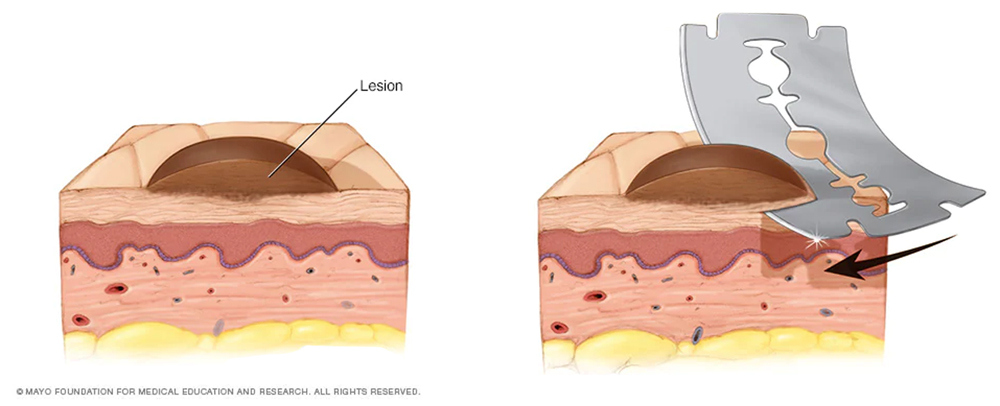
Without seeing you in person, I imagine the mole was removed using a technique called shaving. When we do this, there's no need to suture the wound. If it remains elevated after the procedure, it's important to have your dermatologist examine it to assess whether a touch-up is needed or if laser treatment is possible.
Where can I find you? I need to have my mole removed.
Hello Ericka,
My query is located in Barcelona, Spain
Good evening, I have a mole on my ear. It's noticeable. This mole is round and raised. I don't feel any discomfort, but I'd like to have it removed. Is it possible to do that?
Hello Elizabeth,
Normally, these raised moles don't have problems with removal; however, the most important thing before operating on it is to make a good diagnosis of this lesion, and depending on that, we can tell you which technique is best for removing it.
Best regards
Hello, how are you? I'm interested in...? Report
Hello,
I had a question. I have a mole above my eyebrow. I'm underage, but I like how it looks on me because it makes me feel «special.» I'm worried it will grow a lot. I like how it looks now because it's not very big, but that's the only thing. So, my question is: Does a mole grow a lot as you get older? And how could I have the mole I have now in the future? I know it's not possible because I'm pretty sure it will grow, but I don't want to remove it either. At the same time, I don't like it growing, like, for example, the singer Anaju. It's not that I'm hating on her; she's a great singer to me. She's an example of the mole she has.
Hello Miranda,
I hope you are doing very well. First of all, if you like your mole, you don't have to worry, and I wouldn't touch it. It's possible that in the future it might grow a little bigger, but this normally happens after age 40-50. If at some point you don't like it, it can be evaluated and removed.
Best regards
Hello, good afternoon. I wanted to tell you that I have a mole on my neck, but it's just one small one that sticks out a lot, and I'd like to have it removed. It doesn't hurt or anything, it just sometimes gets caught in my hair.
Thanks, regards
Hello Elizabeth,
It would be good to see this mole in person, but it can probably be removed easily. For that, you should request an appointment and for us to be able to see you in person.
Best regards