
Moles, also called nevi, can appear on the skin in different shapes, sizes and colors. A very characteristic type is the blue nevus or blue mole which is named for its characteristic color.
Although these types of moles are not frequent, are usually benign and are not a cause for concern. However, as in any other it is important to monitor the mole to see if it changes shape or size over time..
Keep reading this article to learn more about these moles and the research studies we are conducting to learn more about them.
What is a blue nevus?
A blue mole is made up of the same cells as the rest of the moles, the melanocytes.
Interestingly, the blue color is due to the pigment being deeper in the skin than ordinary moles and not because it is actually blue. This physical characteristic is called the Tyndall effect and is responsible for the blue color of these moles.
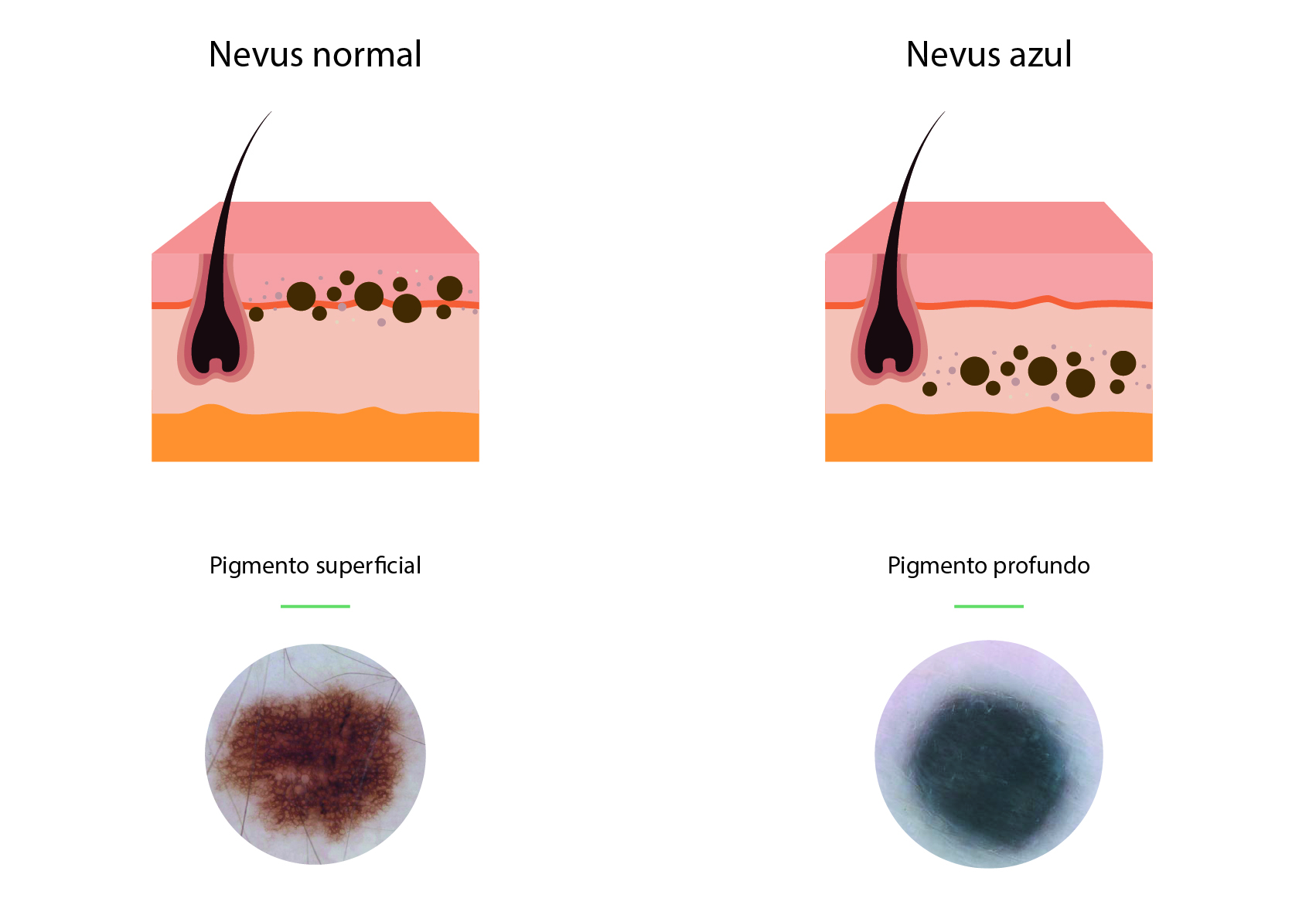
Because the pigment is relatively deep, it is susceptible to the Tyndall effect. That is, there is selective absorption of the longer wavelengths of light by the deep dermal pigment, with reflection from the skin to the eye of the shorter (blue) wavelengths.
What do blue polka dots look like?
Blue nevus has a characteristic blue-blackish color and usually presents as a single lesion of 0.5 to 2 cm anywhere on the body.
Here are some images so you can see what these blue polka dots look like.
Clinical imaging


Dermatoscopic images


Why does a blue mole form?
Most blue nevi appear during the first four decades of life and are rarely present at birth. For reasons that are unclear, women are more likely than men to develop a blue nevus.
Due to the variation in the frequency of blue nevi in different populations, a genetic predisposition has been suggested. However, familial cases of blue moles are extremely rare.
Is a blue mole dangerous?
A blue nevus is not dangerous at all and you can have a benign blue nevus on your skin for your entire life. However, on some occasions there may be malignant lesions that can simulate a blue mole.. That is why in some situations, which I will discuss below, it is advisable to see a dermatologist to check this type of mole.

In summary, blue moles that develop and begin to grow in adulthood may be cause for concern. If you get a blue nevus or other mole after the age of 30 it is best to have it checked out in the office. It may be a sign of skin cancer such as melanoma.
In addition, we have seen that blue moles are very stable over time and changes or growth is rare. Therefore, if we observe changes in blue nevi, it would be advisable to see a dermatologist to check them.
All of the following characteristics of blue nevi are sufficient reason to request an appointment with a specialist to rule out malignancy:
- It has an asymmetrical shape
- Has irregular edges
- Change color over time
- Grow in size or are larger than 6 millimeters
- Protrude from the skin
- Are annoying, painful, itchy or bleeding
If you notice any of these changes, go to your dermatologist to evaluate you.
Is it necessary to remove a blue nevus?
Blue moles are benign lesions and are it is not necessary to remove them if the diagnosis is clear.
If there is doubts about the diagnosis, a complete excision may be considered. of the entire lesion. The melanocytes of a blue nevus are usually quite deep and a superficial biopsy by shaving or attempting to remove them by laser is not possible.
You can also talk to your dermatologist about the removal if the mole is causing you discomfort. For example, if it rubs against your skin or causes other types of irritation.
If the blue nevus reappears after removal, contact your dermatologist. It could be a sign of skin cancer.
Blue nevus research
Together with our research team of the Hospital Clínic de Barcelona we developed the first cohort study to assess the change in the growth of blue moles.
For this purpose, we used image databases of more than 22 years and, by means of artificial intelligence tools, we were able to achieve identify blue nevi among more than 1,000,000 images. Thanks to the intensive follow-up we performed on our patients on a regular basis, we were able to measure the change in size of blue moles over many years. Finally, we were able to plot and explain how this peculiar type of mole behaves.

As a conclusion of the study, we could observe that most of the blue nevi are very stable over time and their size does not change (blue lines). In some less frequent cases, we observed a discrete growth of less than 100%. Only in 2 cases did we see a very rapid growth that required excision of the lesion. to rule out a malignant mole and in these cases we are studying the molecular biology of these tumors.
Blue mole - my findings
Blue polka dots are benign skin lesions and usually appear during the first decades of life.
But if the mole appears later in life (after the age of 30), or if a previous blue mole starts to gradually change over time, you must see your dermatologist to rule out malignancy.
If we decide to remove the mole we will always perform a histological study. This way we can verify the diagnosis, and in the rare case that it is malignant, we can advise you on the steps to follow.





49 Responses
Hello a month ago I had a small mole on my eyelid removed because it came out recently and was irregular. The pathological anatomy gave common blue nevu if atypical. With this article I am more reassured. Thank you
I'm glad everything went very well.
Best regards
This is a clinical case of a baby who was born with a blue spot on the forehead on the left side of the face. In addition there is a small blue discoloration on the eyelid and conjunctiva. Should I send her to a dermatologist or observe her periodically?
Hello Ana,
It is most likely a facial nevus of Ota, you can find more information in the following link. I recommend that you refer her to a dermatologist as laser treatments can greatly improve her condition.
Greetings
Hi I'm Laura, and since I was born I have a blue mole under my thumb, on my right hand in such a way that it is growing as my hand grows, which is also kind of overgrown and when I hit that part it hurts the mole. Should I be worried about that?
Hello Laura, it is most likely that your mole is a congenital nevus and you have nothing to worry about. However, in order to be sure of this, it is important to be evaluated by a dermatologist.
Best regards
Hello, I've had two blue/sky-colored moles since I was born. One is 8mm and the other is much larger. They look like bruises, they've grown with me, and their position has changed. Today I noticed one of them is more swollen. Should I be worried? 😓
Hello Macarena,
It is probably nothing important and is the normal evolution of these blue moles. However, if you can go to a dermatologist to have it checked it would be the most advisable thing to do.
Best regards
Good afternoon, I have a small blue mole on my hand and I went to the dermatologist and she advised me to remove it and send it to be studied. The only thing I notice is that it is just protruding from the skin, it does not cause itching or pain. She told me that if it has been there for 5 years it is necessary to remove it, but I don't want to. Is it necessary according to her opinion?
Thank you Gabriela
Hi Gabriela, to be able to give you a specific recommendation about your mole I would have to see it in person and examine it with dermoscopy. I would think that if your dermatologist has evaluated it and considers that it is better to remove it, I would listen to him/her.
Best regards
Thank you for answering, yes, I look at it with a magnifying glass and he told me to take it out in case I have had it for 5 years, if it was a lifetime I didn't need it, he said. Well I will follow your advice then. Thank you very much...
My sister, 60 years old, started with a tiny one in her hand and it never changed in size, after 4 years we met again and she showed me that now she has two or three more just as small.
Hello Antonia,
I hope you are doing very well. It is not so common for these moles to appear in adulthood, although they can. It would be good to have her seen by a specialist at some point.
Hello,
After a Photofacial I developed 2 small blue moles on the upper lip.
I noticed it happened when I saw an orange light and smell of burning.
Have there been any such cases, and are they of concern?
Thank you
Estimada Ana, por la descripción de tu problema es muy difícil saber qué ha pasado. Si han ocurrido justo después de un tratamiento de fotorrejuvenecimiento podría tratarse de una hiperpigmentación post-inflamatoria. Sin embargo habría que verlo para estar seguros.
Yo nací con un lunar azul en el brazo, cerca del hombro, a la edad de nueve años se convirtió en maligno, me operaron una primera vez y luego de analizarlo volvieron a operar y vaciaron totalmente hasta el hueso. Voy a cumplir ochenta años y nunca más tuve problemas
Hola Clemy,
Sin lugar a dudas es un caso muy interesante y afortunadamente la evolución en tu caso ha sido muy buena. Por lo que cuentas este lunar se ha quitado hace 70 años. El diagnóstico del melanoma y los estudios al microscopio han cambiado radicalmente durante todo este tiempo y la clasificación de tumores de la piel es muy distinta que en aquellos años. Para saber lo que tuviste en aquel entonces sería necesario volver a revisar este lunar al día de hoy.
Siempre tuve un lunar azul desde que era pequeña, pero creo que es por herencia por mis tias y mi abuela que también lo tienen.
Hola Karen,
Los lunares azules son relativamente frecuentes. Si lo tienes desde el nacimiento y no presenta cambios puedes estar tranquila. Muchos saludos
Buenas tardes… Viendo el gráfico del seguimiento de los nevus azul que han hecho seguramente yo sería una de esas lineas rojas. Tengo un nevus azul en mi oreja izquierda en la parte superior. Aparecio hace unos dos años y crecio mucho en en transcurso de estos dos años. Hasta se han confundido y me han dicho que tengo un bicho en mi oreja. Esta semana concurri a la consulta con la dermatóloga y me sugirio la extracción del mismo. Por cuestiones de que es muy grande para el lugar en que se encuentra. En cuanto tenga los estudios histopatologicos se los puedo hacer llegar si son de su interés. Muchas gracias por la información que publica. Muy interesante y de mucha ayuda.
Saludo atentamente.
Alejandra. 32 años. Argentina.
Estimada Alejandra,
Yo creo que has hecho bien de acudir al dermatólogo para que lo pueda evaluar. Una vez que tengas los resultados sería muy interesante que los puedas compartir.
Pd. Me alegro mucho que te gusten los artículos y me alegro que puedan ser de ayuda.
Intento dentro de lo posible concurrir una vez al año a la consulta con la dermatóloga para controlar mis lunares. Tengo muchos y soy de la generación donde no nos cuidaban del sol. Llevo extraidos unos cuantos nevus pero este el primer nevus azul. La extracción se realizo el dia lunes 2/8. En cuanto tenga los resultados se los compartiré. Gracias por su respuesta. Ojala mas personas se interesaran por la.salud de su piel. Gracias nuevamente por toda la información que brinda.
Atte. Alejandra.
Hola, muchas gracias por la información.
Tengo un lunar de color azul, bien parecido al que aparece en una de las imágenes, y siempre ha sido del mismo tamaño. Recuerdo que ya desde año 2012 cuando tenía 17 años y ya lo tenía y no se si siempre lo habré tenido, porque de niña uno no se fija en esas cosas. Mi duda, ¿Tendré que preocuparme más de lo normal como para pensar que pueda ser un melanoma? A veces dudo de eso pero pienso que si fuera así por los años ya estaría mucho peor. Voy a ir de todas formas con un dermatólogo.
Hola Tania, si tu lunar se ha mantenido siempre igual y no ha crecido durante lo últimos años posiblemente se trate de un lunar azul totalmente benigno. Sin embargo, haces muy bien de querer ir al dermatólogo, ya que en la consulta lo podemos confirmar en un momento con el dermatoscopio y así nos quedamos muy tranquilos. Muchos saludos
Hola. Acabo de descubrir que tengo un lunar con bordes azules, detrás del lóbulo de mi oreja izquierda. Tengo la sensación que lleva bastante tiempo ahí. Lo sentía al tacto, pero nunca lo observé. No me duele ni me molesta para nada, pero su apariencia es muy fea y me preocupa mucho. ¿Puedo adjuntar la foto para que me des tu opinión?, te lo agradecería mucho.
Estimada Fabiola,
En el caso de que aparezcan nuevas lesiones en nuestra piel, siempre es aconsejable consultar con un dermatólogo de forma presencial. Esto es necesario porque una parte fundamental del examen de nuevos lunares es la utilización de la dermatoscopia para poder saber el diagnóstico de esta lesión que te ha aparecido.
Best regards
Excelente información (y yo que pensaba que era de sangre azul, por tener un lunar de ese color, je je je)
Muchas gracias,
Me alegro que podamos solucionar algunas dudas al respecto.
Greetings
Gracias ahora estoy informada porque nunca hacia sabido nada acerca de mi lunar… Lo tengo arriba de mi ceja izquierda pegada al crecimiento del cabello
Hola Yesenia,
Me alegro mucho que este artículo te haya servido para aclarar tus dudas. Lo importante es que no crezca y se mantenga muy estable durante los años.
Greetings
Muy buena información muchas gracias!
Muchas gracias David,
Me alegro que sea de utilidad.
Greetings