
This content is independent medical disclosure. I have no commercial relationship with any laboratory manufacturer of the treatments mentioned. This article is for educational purposes and is not a substitute for individualized assessment by your medical team.
If you have been diagnosed with melanoma and your medical team has told you about immunotherapy, it is normal that you have many questions. What exactly is it? How does it work? What are the side effects? This article is intended to help you understand the treatment options for immunotherapy in melanoma, from neoadjuvant to advanced melanoma.
Something I want you to keep in mind from the beginning: each patient is unique. There is no universal treatment for melanoma. The decision to start, modify or stop treatment always involves weighing the risks of recurrence against the possible toxicity of the treatment, taking into account your personal situation.
My name is Sebastian Podlipnik and I am Dermatologist at the Melanoma and Skin Cancer Unit of Hospital Clínic de Barcelona. I work daily with patients receiving immunotherapy and participate in treatment decisions together with the multidisciplinary team. I want to share with you what I explain to my patients in consultation, with the most current scientific evidence.
What is immunotherapy and why does it work in melanoma?
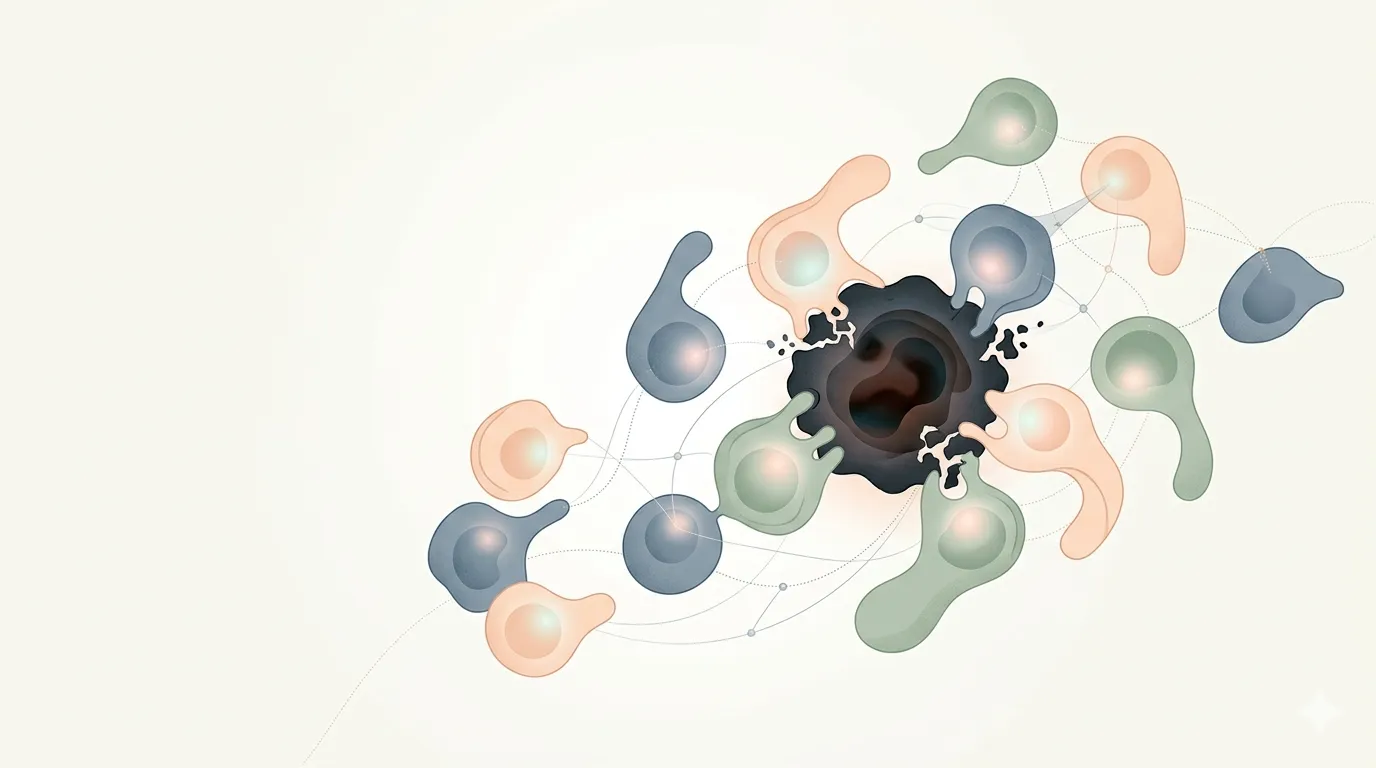
Immunotherapy is a treatment that helps your own immune system recognize and attack melanoma cells. Unlike chemotherapy, immunotherapy does not destroy the tumor directly, but “unlocks” your body's natural defenses. to be eliminated by them.
How does it do this? Melanoma cells use cell surface proteins (called PD-1 and CTLA-4) as “brakes” to hide from the immune system. Immunotherapy drugs, known as checkpoint inhibitors, block these brakes and allow T cells to re-detect and destroy the tumor.
- Checkpoint inhibitors (immune checkpoints)
- Drugs that block PD-1 or CTLA-4 proteins, allowing the immune system to recognize and attack tumor cells. They are the most widely used type of immunotherapy in melanoma.

Melanoma is one of the tumors that best responds to immunotherapy. The main reason is that it accumulates a high number of mutations in its DNA (what we call high mutational load), and this gives the immune system more “clues” to distinguish tumor cells from normal cells. To better understand the different types of skin cancer and its characteristics, you may find this other article useful.
In what stages of melanoma is immunotherapy used?
Immunotherapy is not indicated in all melanomas. It is used after certain stages where the risk of recurrence or progression justifies systemic treatment., generally from stage IIB onwards, according to the AJCC (American Joint Committee on Cancer) classification.
In simplified form, the stages of melanoma are grouped as follows:
- Stages I and IIA: melanoma is limited to the skin, is thin and has a low risk of recurrence. It is usually treated with surgery and does not require immunotherapy.
- Stages IIB and IIC: the melanoma is still in the skin but is thicker or has higher risk features (such as ulceration). Adjuvant immunotherapy may be considered here.
- Stage III: melanoma has reached the regional lymph nodes. This is where immunotherapy (neoadjuvant or adjuvant) has a very relevant role.
- Stage IV: melanoma has spread to other organs (distant metastases). Immunotherapy is the first-line treatment.
But the stadium is only part of the equation. The decision to treat does not depend solely on the number of stage. We also assess the patient's general condition, age, comorbidities (other diseases they may have), BRAF mutation, expected tolerance to treatment and, of course, the individual's own preferences. Two patients with the same stage may receive different recommendations because their individual context is different.
Moreover, these decisions are not made by a single physician. In specialized centers, each case is presented in a tumor committee, a meeting where dermatologists, oncologists, surgeons, radiologists, pathologists and other specialists jointly review the situation of each patient and agree on the best treatment strategy. If you are interested in going deeper into the factors that influence prognosis, I explain it in detail in my article on prognosis in melanoma.
Neoadjuvant immunotherapy: before surgery
Neoadjuvant immunotherapy consists of administering immunotherapy formerly surgery, when the melanoma is still present in the body. It is one of the most important advances in melanoma treatment in recent years. The idea is that the immune system learns to recognize the tumor “in vivo”.”, The immune response is more complete and long-lasting than if it is administered after removal.
The NADINA trial, published in the New England Journal of Medicine in 2024, compared neoadjuvant therapy with a combination of anti-PD1 + anti-CTLA4 versus adjuvant therapy alone in resectable stage III melanoma. The results were compelling: event-free survival of 83.7% at 12 months with neoadjuvant versus 57.2% with adjuvant alone. Of the patients, 59% achieved a major pathological response, which means that at the time of surgery, most of the tumor had already been eliminated by the immune system itself. [(Blank et al., 2024)].
In our center we use pembrolizumab monotherapy as a neoadjuvant regimen, although other centers and clinical trials use the combination of nivolumab + ipilimumab (as in NADINA). Guidelines are continually evolving as new results are published, and what is the standard today may change in the coming months.
Neoadjuvant therapy is not suitable for all situations. Your doctor will assess with you if it is the best option in your case.

Adjuvant immunotherapy: after surgery
Adjuvant immunotherapy is administered after surgical removal of the melanoma to reduce the risk of recurrence. It is considered in patients with stages IIB to IV resected, where the risk of recurrence is significant..
Clinical trials have shown that adjuvant anti-PD1 improves 5-year recurrence-free survival: 50% vs. 39% with other treatments in resected stage III/IV melanoma. [(Larkin et al., 2023)]. Treatment usually lasts approximately one year, with intravenous infusions every 3-6 weeks depending on the drug.
“What I always tell my patients is that we have options today that didn't exist just a few years ago. But having more options also means that every decision matters. That's why we weigh recurrence risks versus toxicity together on a case-by-case basis.”
Dr. Sebastian Podlipnik
Not all patients who have undergone melanoma surgery need adjuvant treatment. A patient with stage IIB melanoma in good general condition poses a different conversation than a patient with stage IIIC and multiple nodes involved. Tumor thickness, presence of ulceration, lymph node involvement, age, comorbidities and the patient's own preferences all play a role. In consultation I always spend time explaining these pros and cons so that the person can actively participate in the decision.
Have you been diagnosed with melanoma and need guidance?
I can help you assess your case. Choose the option that best suits you.
Immunotherapy in advanced melanoma
When the melanoma has spread to other organs (stage IV) or it is not possible to remove it surgically, immunotherapy is the first line of treatment. In this context, the objective is to control the disease in the long term.
To put into perspective what immunotherapy has meant: 15 years ago, 5-year survival in stage IV melanoma was less than 10%. Today, in clinical trials, about 50% of patients treated with immunotherapy combination are alive at 5 years. [(Carlino et al., 2021)].
<10% → ~50%
5-year survival in stage IV (metastatic) melanoma: before and after immunotherapy based on clinical trial data.
At 10 years, the CheckMate 067 trial shows that 37% of patients treated with the combination of nivolumab + ipilimumab are still alive, with a median survival of almost 6 years (71.9 months). [(Wolchok et al., 2024)]. With pembrolizumab in monotherapy, the 10-year follow-up of the KEYNOTE-006 trial shows a survival of 34%. [(Long et al., 2024)].
However, it should be borne in mind that these are data from clinical trials with selected patients. Factors such as tumor burden, location of metastases or general health status influence the response. Your physician can guide you as to what is most likely in your situation.
In order to understand how to plan the follow-up after treatment of melanoma, you may be interested in this other article.
What types of immunotherapy are available for melanoma?
Immunotherapy treatments for melanoma are based on checkpoint inhibitors, classified according to the protein they block. There is no universal drug: the choice depends on the clinical scenario, the patient's profile and the individual risk-benefit balance..
- Anti-PD1 (pembrolizumab, nivolumab): are the mainstay of treatment in virtually all scenarios (neoadjuvant, adjuvant and advanced melanoma). They have a generally manageable side effect profile.
- Anti-CTLA4 (ipilimumab): blocks a different brake of the immune system. It is mainly used in combination with an anti-PD1.
- Anti-PD1 + anti-CTLA4 combination: offers the highest response rates in advanced melanoma (52% of patients alive at 5 years in the CheckMate 067 trial). [(Larkin et al., 2019)] However, it carries greater toxicity: up to 59% of serious adverse events. [(Wolchok et al., 2017)]
| Type | Drug | Primary use | Tolerance |
|---|---|---|---|
| Anti-PD1 | Pembrolizumab, nivolumab | Neoadjuvant, adjuvant, advanced melanoma | Generally well tolerated (severe events 15-20%) |
| Anti-CTLA4 | Ipilimumab | In combination with anti-PD1 | More adverse effects than anti-PD1 alone |
| Combination | Nivolumab + ipilimumab | Advanced melanoma, neoadjuvant therapy | Higher efficacy, but up to 59% of severe events |
When the melanoma is BRAF mutated (approximately 40-50% of cutaneous melanomas), there is an additional therapeutic option: targeted therapy with BRAF and MEK inhibitors. Both immunotherapy and targeted therapy are effective, and European and international guidelines recommend considering immunotherapy as the first option in most situations, reserving targeted therapy for cases with rapid progression or high tumor burden where a more immediate response is needed. [(Seth et al., 2023)]. [(Garbe et al., 2024)].
Immunotherapy side effects: how are they managed?
The side effects of immunotherapy are different from those of chemotherapy. They are called immune-mediated adverse events and occur because the immune system, when activated against the tumor, may also react against the body's own healthy tissues. The good news is that most are mild or moderate in intensity and reversible with proper treatment. [(Ramos-Casals et al., 2020)].
The frequency varies according to the type of treatment. With anti-PD1 monotherapy, the most common are fatigue, skin rashes and thyroid disorders (hypothyroidism, in approximately 8% of patients). With the combination, the incidence is higher: diarrhea (up to 29%), skin rash (31%) and colitis (8%). [(Xu et al., 2020)].
The key is early detection. When an adverse effect is identified early, management is usually simple: close follow-up, dose adjustment or treatment with corticosteroids in cases that require it.

The future of melanoma treatment
Melanoma research is advancing at a pace that would have been difficult to imagine just a few years ago. Treatment guidelines are continually changing with new clinical trials, and what is the standard today may evolve in the coming months.
Some of the most promising lines of research include:
- Tumor infiltrating lymphocyte (TIL) therapy: consists of extracting lymphocytes from the patient's own tumor, multiplying them in the laboratory and reinfusing them. It is already approved in some countries for advanced melanoma that has not responded to other treatments.
- New checkpoint inhibitors: drugs that block different targets, such as LAG-3 (relatlimab), which is already used in combination with nivolumab in certain situations.
- Personalized vaccines: vaccines tailored to each patient's tumor, in advanced stages of clinical research.
Fortunately, today we have treatment options for melanoma that are far better than what we had a decade ago. And the trend is for them to continue to improve. If you are undergoing treatment or considering options, ask the professionals treating you about the clinical trials available at your center.
Frequently asked questions about melanoma immunotherapy
Is melanoma curable with immunotherapy?
In clinical trials, immunotherapy has achieved that 37% of patients with metastatic melanoma (stage IV) are still alive at 10 years. Although technically we are not talking about “cure” in the classical sense, many patients achieve durable responses that are maintained years after the end of treatment. In earlier stages (II-III), immunotherapy significantly reduces the risk of recurrence after surgery. Results vary from person to person.
How long does immunotherapy treatment last?
It depends on the context. In neoadjuvant treatment, 2-3 cycles are administered before surgery. In adjuvant treatment it usually lasts approximately one year. In advanced melanoma, treatment can be prolonged up to two years if there is a good response. Your doctor adjusts the duration according to the response and tolerance of each patient.
Is it possible to live a normal life during immunotherapy?
In general, yes. Immunotherapy is administered intravenously in the hospital, usually every 3-6 weeks. Most patients maintain their usual activity between sessions. The most frequent side effects (tiredness, mild discomfort) are usually transitory. Of course, do not skip the scheduled analytical controls: they allow any alteration to be detected in time.
What happens if immunotherapy stops working?
If the melanoma progresses during or after immunotherapy, there are second-line options that you will discuss with your physician. These include: switching to combination therapy (if you were receiving monotherapy), using targeted therapy (if there is a BRAF mutation), or considering participation in clinical trials with new molecules. Fortunately, research is advancing rapidly and new options are appearing every year.
Does immunotherapy work for all stages of melanoma?
No. Immunotherapy is indicated from certain stages with significant risk of recurrence or advanced disease (generally from stage IIB onwards). Thin melanomas completely removed by surgery (stage I and IIA) usually do not require further treatment. The early detection is still the factor that most influences the prognosis.
Your medical team is there to help you
Melanoma medicine is changing very rapidly. Today we have options that were unthinkable just a few years ago, and the results continue to improve. If you are in the process of deciding on a treatment, if you have just started immunotherapy or if you simply want to better understand what has been explained to you in consultation, I hope you have found this article useful.
Remember: the best decision is the one made with information and the support of professionals who know your case.. Don't hesitate to ask questions, to ask for a second opinion if you need one, and to actively participate in decisions about your health.
And one last thing I want to mention: facing a melanoma diagnosis and a treatment such as immunotherapy has an emotional impact that we should not ignore. It is completely normal to feel uncertainty, fear or anxiety.. If you need it, ask your medical team to direct you to a psycho-oncology service or a patient association. Taking care of your emotional well-being is as important as the treatment itself. If you have a mole that worries you or you want an appraisal, I'm here to help you.
Do you want a professional assessment?
I can help you. Choose the option that best suits you.






 Spanish
  English