
Melasma affects 90% of women with Mediterranean phototypes, the exact profile I see every week in my practice. Most arrive after years of treatments that haven't worked, looking for a "definitive" laser or cream to erase the spots overnight. This search for a miracle is precisely the first obstacle. Melasma is a chronic condition: it cannot be cured all at once; it is managed. What exists is a graduated protocol and ongoing maintenance care that, in the vast majority of cases, achieves an even skin tone and keeps it that way for years.
My name is Sebastian Podlipnik and I am Dermatologist at the Melanoma and Skin Cancer Unit of Hospital Clínic de Barcelona. In this article, I will explain the treatment of melasma as I would in consultation: with real data, without deceptive marketing, and with options ordered by scientific evidence updated to 2026.
What is melasma and why is it so common in Mediterranean women?
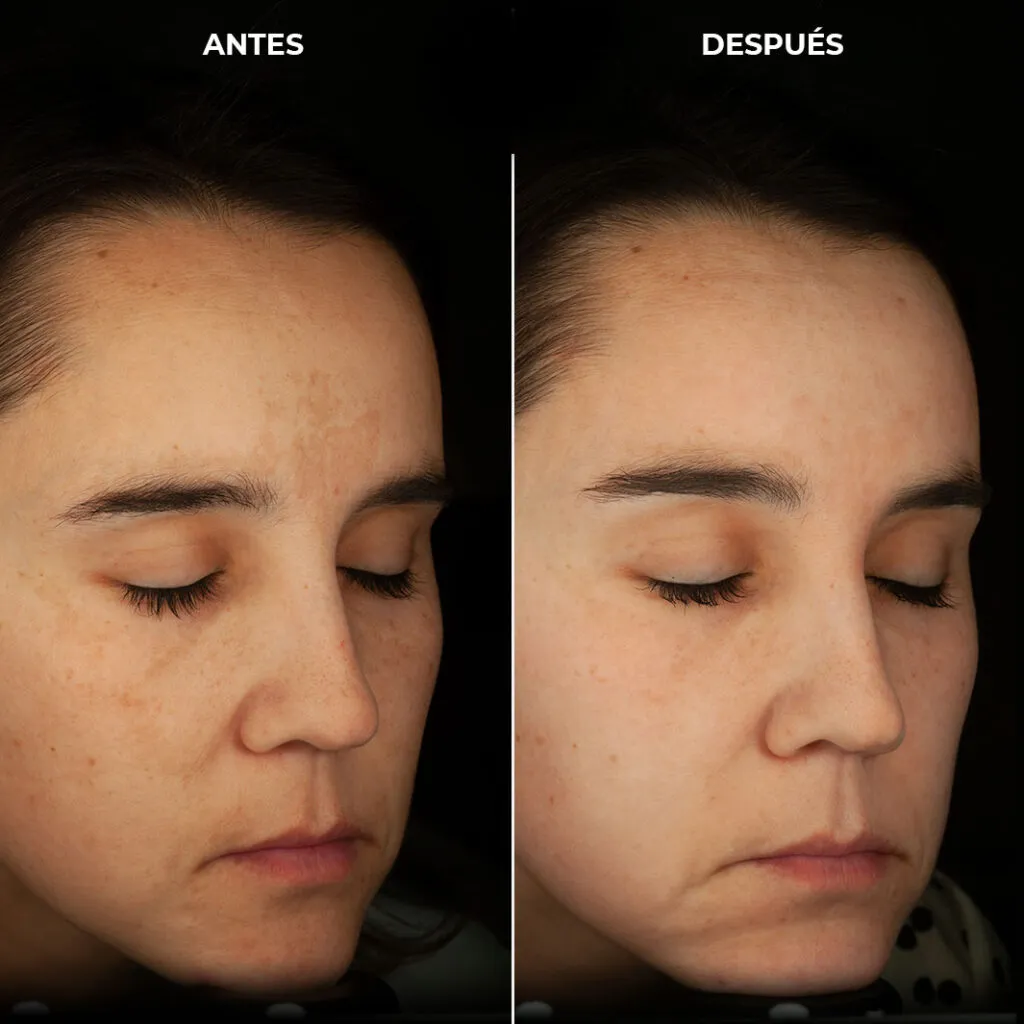
Melasma is characterized by symmetrical brown or grayish patches that primarily appear on the face. It is a chronic acquired hyperpigmentation, meaning it is not present at birth, develops over time, and does not resolve on its own. It affects 90% of women, particularly those with skin phototypes III-IV, which are the most common skin tones in Spain and the Mediterranean (skin that tans easily and burns infrequently). The cause is not singular: the sun and visible light activate melanocytes (the cells that produce skin pigment), but hormones, genetics, or certain medications must be present for the patches to appear. (Sarkar et al., 2025)

The most relevant causes I see in consultations are:
- The sun and visible light are the main factor. Skin has a memory: all the sun you've gotten since childhood adds up.
- Hormones are the second major trigger. Pregnancy (what is called gestational melasma) and oral contraceptives increase estrogen and progesterone, which directly stimulate pigment production.
- Genetics determines the prognosis. If your mother or sister has melasma and you also have darker skin, melasma is more difficult to control and it's advisable to start with a more comprehensive protocol from the beginning.
- Some medications also make it worse. Certain antibiotics, anti-inflammatories, and hormone replacement therapies, especially at high doses, can cause or worsen melasma (they are called phototoxic because they make the skin sensitive to the sun). (Abdeen et al., 2026)
The emotional impact is real, and it shouldn't be downplayed. Studies show that melasma affects quality of life just like other chronic skin conditions: anxiety, low self-esteem, and a reduced desire to be in social situations. Treating melasma isn't just about aesthetics; it's about health. (Ribeiro et al., 2025)
- Visible light (380-780 nm)
- The light you see with the naked eye (distinct from UV rays). Along with UVA and UVB, it activates melanocytes in darker skin. Most conventional sunscreens only block UV rays, so this factor often goes unnoticed.
Does melasma have a cure? What recent evidence tells us
Melasma has no definitive cure in most cases. It is a chronic condition, like rosacea or atopic dermatitis, and that completely changes the way treatment is approached. The goal is not to "erase" the spots in one season, but to inactivate the melanocytes (the cells that produce pigment) and keep them dormant for years. The most recent studies show that between 60% and 90% of patients achieve significant improvement with a stepped protocol, but those who maintain the results are the ones who embrace maintenance as part of their daily routine, not as a treatment with an expiration date. (Sarkar et al., 2025)

What is definitive is this: If you don't control the triggers, no melasma treatment will work long-term. I've seen patients who have invested thousands of euros in procedures, only to see the melasma return the following summer because they weren't using sunscreen with visible light filters. The sun is the main enemy, but not the only one.

To effectively get rid of melasma and prevent its return, my protocol always has two phases: first, treat the active spot, and once it's controlled, maintain the results with photoprotection and retinoids (vitamin A derivatives) in your daily routine. Stopping treatment when the skin is already clear is the most common mistake patients make. For a broader view of facial spots in general, consult the Complete Guide to Facial Spots.
Are there types of melasma? Why is the classic classification outdated?
For decades, it has been said that melasma is classified into three types (epidermal, dermal, and mixed) according to the depth at which the pigment is located, as viewed with a Wood's lamp (a special lamp used in dermatology). Modern evidence, from 2020 onwards, shows that this classification does not hold up: Melasma is always superficial (epidermal), and what used to be called "dermal" is usually something else entirely, requiring different treatment. This isn't an academic detail: getting the diagnosis right changes what works and what doesn't.

When biopsies of patients with melasma are studied under the microscope, the same thing is always seen: an increase in melanin in the superficial layer of the skin (epidermis), with hyperactive melanocytes. When "deeper" pigment is seen, it is actually melanophagesCells that clean the skin, which have consumed melanin falling from above due to chronic damage. Next to them appear dilated blood vessels, mast cells (inflammation cells), and solar elastosis (accumulated sun damage). These are phenomena that accompany melasma, not a distinct type. (Khunger et al., 2020) (Ali & Al Niaimi, 2025)
And Wood's light? It remains useful as a consultation aid, but not as a basis for deciding on treatment. Studies comparing it with other more advanced techniques (dermoscopy and confocal microscopy) find considerable disagreement among dermatologists about what type of melasma they are seeing. The most recent international guidelines, published by the European Academy of Dermatology (EADV 2025 Delphi consensus), no longer use it to decide which treatment to apply. (Sarkar et al., 2025)
So, if they tell you that you have "refractory dermal melasma" and propose an aggressive laser treatment for it, It is reasonable to ask for a second opinion.. Deep facial pigmentations are actually other diseases, each with its own treatment:
- Exogenous ochronosis: Gray-blue spots from prolonged, uncontrolled use of hydroquinone. It is not melasma, it is an adverse effect. The treatment is to stop using hydroquinone. (Agrawal et al., 2026)
- Acquired Deep Hyperpigmentations (ADMH) a group that includes lichen planus pigmentosus, ashy dermatosis, Riehl's melanosis, and pigmented contact dermatitis. None are melasma. (Shah et al., 2023)
- Post-inflammatory hyperpigmentation (PIH): The dark spot that remains after acne, dermatitis, a poorly indicated laser, or any inflammation on the face. It resembles melasma, but the treatment is different.
- Hori's Nevus melanocytes that have remained in a deep layer where they shouldn't be. They do respond to a specific type of laser (Q-switched), but it's not melasma.
What really serves to decide the treatment isn't the "type" by Wood's lamp, but: the gravity (mild, moderate, or severe), the antiquity (months or years), the factors that are making it worse right now (pregnancy, birth control, unprotected sun), if any Redness or visible blood vessels (vascular component) and, above all, a well done diagnosis rule out everything else before assuming it's melasma.
Before going into detail on each treatment, here is the general map ordered by level of evidence and risk:
| Treatment | Efficacy | Risk | When to use it |
|---|---|---|---|
| Sun protection SPF50 + iron oxide |
Mandatory base; 15%% additional improvement over SPF50 without visible light filter | Null | Always, 365 days a year |
| Triple topical combination Hydroquinone + tretinoin + corticosteroid |
Reduce ~5.6 points on the MASI scale; more effective than laser | Under (irritation, dermatitis if prolonged more than 8-12 weeks) | First active line |
| Oral tranexamic acid 250 mg every 12 hours |
Reduce ~59% of spots in 12 weeks (n=50) | Low (caution if there's a history of thrombosis) | Complement or alternative to clichés |
| Picosecond laser Alexandrite 755 nm |
Reduce ~3.8 MASI points; less effective than creams | PIH up to 7 times more frequent than with creams | Last resort, always with prior preparation |
Data: Castanedo-Cazares 2014 (photoprotection), Chua 2026 meta-analysis (triple combination vs. laser), Heidary 2025 (oral TXA), Wang 2023 (laser).
Sun protection: The foundation that never fails
Sun protection is the only melasma treatment that works on its own, without anything else. No other can say the same. A broad-spectrum SPF50 sunscreen with visible light filter (iron oxide or colored titanium dioxide), applied daily and reapplied every two hours, is the irreplaceable cornerstone of treatment according to the international consensus of 38 dermatologists from 11 countries (Delphi consensus). (Sarkar et al., 2025)
Regular sunscreen isn't enough if you have darker skin. A meta-analysis from the British Journal of Dermatology, which reviewed 36 clinical trials, confirmed that visible light-filtering sunscreens reduce melasma more than those that only block UV rays. The reason: a specific part of visible light (between 415 and 430 nm, in the blue spectrum) directly activates pigment production in darker skin. (Pennitz et al., 2022)
"The best melasma treatment doesn't exist without impeccable sun protection. It's the foundation upon which we build everything else. Without it, any cream or laser we use is a waste of time and money."
Dr. Sebastian Podlipnik
In practice, check the sunscreen label for the words "iron oxide" or "pigment": tinted versions (beige or sand tones) usually contain this extra filter. In addition to sunscreen, avoiding direct sun between 11 AM and 4 PM, wearing a wide-brimmed hat, and UV-protective clothing multiply the treatment's effectiveness. LED screen light also emits in the relevant range, although its impact is much lower than direct sun.
Would you like a personalized assessment of your melasma?
I will help you identify the type of melasma you have and design the most suitable protocol for your case.
Topical treatment: triple combination and hydroquinone
The triple combination (hydroquinone 4%%+ tretinoin 0.05%% + a mild corticosteroid, fluocinolone acetonide 0.01%%) is the only FDA-approved cream for melasma and the most effective according to current evidence. It acts on three fronts at once: it slows down the enzyme that produces pigment (hydroquinone blocks tyrosinase), it speeds up skin renewal to eliminate accumulated pigment (tretinoin, a vitamin A derivative), and it reduces inflammation that causes the dark spot to persist (corticosteroid). It should not be used for more than 8-12 weeks consecutively to avoid adverse effects. (Mahajan et al., 2022)

A 24-week clinical trial conducted at the University Hospital of Nice (n=40) demonstrated that an alternative formula using isobutylamido-thiazolyl-resorcinol instead of hydroquinone achieves equivalent results and is better tolerated, an important factor in the European Union, where hydroquinone is restricted in cosmetics. Generic versions, on the other hand, achieve the same efficacy and safety as the reference brand. (Bertold et al., 2023) (Hu et al., 2025)
- MASI (Melasma Area and Severity Index)
- The "melasma score." It's a scale from 0 to 48 that dermatologists use to objectively measure severity. It sums up the affected surface area, how dark the spots are, and how uniform they are. The higher the number, the worse the discoloration. This is how we objectively compare if a treatment is working.
For creams to work, the way they are applied matters almost as much as the formula: a thin layer, covering the entire affected area, at night (in the case of the triple combination), and with sunscreen the next day without exception. Applying the cream incorrectly can reduce its effectiveness by half.
An important note before we talk about the laser: Laser is not a treatment for melasma. Most patients who come in asking for it would improve more, and with much less risk, with strict sun protection and a well-executed cream protocol. Laser is a specific tool for specific cases, not a general solution. Understanding this saves you expensive decisions and, in the worst-case scenario, prevents melasma from worsening after treatment.
Tranexamic acid: the oral revolution and other routes
Tranexamic acid in pill form is currently the alternative with the most growing evidence for melasma. It works from the inside: it cuts off communication between keratinocytes (the main skin cells) and melanocytes, thereby reducing pigment production. In my practice, I use it in patients who do not tolerate creams well or as a booster when the triple combination alone is not sufficient. (Chen et al., 2024)
A meta-analysis of 17 clinical trials compared different administration methods and found that skin-injection versions (intradermal and microneedling) are the most effective, but the pill remains the best daily option due to convenience and tolerance. The usual regimen is 250 mg every 12 hours for 8 to 12 weeks. (Chen et al., 2024)
At these doses, it is a safe drug. The most frequent side effects are mild stomach discomfort that goes away on its own. It should not be used in patients with a history of thrombosis without prior evaluation, and in women taking high-dose contraceptives, the risk must be assessed on a case-by-case basis. If your melasma is related to pregnancy, I recommend you also read the article about sunbathing during pregnancy, where I explain what sun protection is safe at that stage.
Laser: When to use it, when not to, and why phototypes III-IV are delicate
I want to start this section with a clear idea: Laser is not a treatment for melasma. It's a support tool for very specific cases, not an alternative to photoprotection and creams. In phototypes III and IV, the most common in Spain, an overly aggressive laser can leave what's called post-inflammatory hyperpigmentation (a new dark spot that appears as a reaction to the laser's own aggression), and that spot is usually harder to treat than the original melasma. If your dermatologist suggests a laser before optimizing photoprotection and creams, get a second opinion. (Chua et al., 2026)
The triple combination cream outperforms picosecond laser (755 nm alexandrite). When reducing melasma, according to a meta-analysis of 5 clinical trials published in 2026. Furthermore, the chances of a new spot appearing as a reaction to the treatment itself were almost 7 times higher with the laser than with the cream, although this data is based on few studies and should be taken with caution. This is the finding that most surprises patients who arrive convinced that the laser is the definitive solution. (Chua et al., 2026)
Another meta-analysis, this one of 11 trials, showed that combining laser with cream yields better results than cream alone from 8 weeks onward, but with a drawback: adverse effects appear 9 times more often than with cream alone. The combination may improve outcomes, yes, but the risk is real and must be managed well. (Fithria et al., 2026)

Does this mean that laser treatments should never be used for melasma? No. It means they should be done with preparation and in the correct context:
- Preparation is mandatory. At least 4-6 weeks beforehand with triple combination and strict sun protection to calm melasma and prevent the laser from worsening it.
- Not all lasers are worth it. Pulsed, low-intensity, and non-ablative fractional lasers are safer on dark skin than conventional Q-switched lasers.
- Only in very specific cases. Severe melasma that has not responded to 4-6 months of appropriate photoprotection, triple combination, and tranexamic acid. Or cases where it has been confirmed that the melasma is not melasma, but something else (e.g., Nevus of Hori or lentigo solar), which do respond well to laser.
If you're offered a laser treatment for melasma, ask: What type of laser? What pre-treatment preparation? What is the post-procedure protocol? If there isn't a clear answer, seek a second opinion. Laser treatments work very well for other types of spots, such as sun spots, which are indeed flat spots from cumulative exposure and respond much better to laser than melasma. In my practice Laser dermatology I perform a preliminary evaluation to identify what type of stain you have before proposing any procedure.
Chronicity and Maintenance: How to Prevent Melasma from Returning
If you only take one idea away from this article, let it be this: The real treatment for melasma is maintenance. Melasma is a chronic condition that returns if left untreated. What differentiates patients who maintain even skin for years from those who live in a cycle of improvement and relapse is not having found a miracle cream or the ultimate laser, but rather having accepted that sun protection and a mild retinoid are part of their daily routine, every day, forever. It's not a sentence, it's a condition that is managed just like any other chronic skin condition.

The key maintenance points I share with my patients:
- Sun protection 365 days a year: Not just in summer. Indoor lighting and cloudy days also stimulate pigment production in sensitive skin.
- Maintenance retinoids 1-2 nights per week: Retinol or low-dose tretinoin (they are vitamin A derivatives) keep the skin in constant renewal and prevent pigment from accumulating again.
- Warn before changing hormones: If you are going to start taking contraceptives or hormone therapy, tell your dermatologist that you have melasma so they can assess the risk.
- Treat in autumn and winter: This is the best time for the active phases of treatment because there is less sun and the risk of melasma returning is lower.
If you want to go deeper with detailed protocols by type of stain and phototype, I explain it step by step in the book on facial blemishes.
Frequently Asked Questions about Melasma
These are the questions I get asked most frequently in consultations and on social media, answered with the same frankness I would use with any patient.
- Is there a cure for melasma, or does it always come back?
- Melasma has no definitive cure in most cases, but it is very well controlled. It is a chronic condition: if you stop maintenance treatment or expose yourself to the sun again without protection, it tends to reappear. With the correct protocol, the vast majority of patients achieve almost uniform skin and maintain that result for years.
- What is the best treatment for melasma?
- There is no single "best treatment." Looking for a miracle cure is what usually leads patients to spend money on expensive lasers that don't work or make dark spots worse. The real treatment is consistent and stepped: daily visible light filter photoprotection as a base, a triple combination cream as the first active line, tranexamic acid in pill form as an alternative or reinforcement in moderate to severe cases, and laser only in specific cases and with prior preparation. The key is consistency in maintenance, not the power of the procedure.
- Is oral tranexamic acid safe?
- At the doses we use for melasma (250 mg every 12 hours for 8 to 12 weeks), it is a safe drug. The most frequent side effects are mild stomach upset. It cannot be given without prior medical evaluation in patients with a history of thrombosis. In my practice, I prefer to do cycles with breaks rather than prolonged continuous use.
- Can melasma be removed with laser?
- Yes, in selected cases and with proper preparation. The problem is that in Mediterranean or darker skin tones (phototypes III and IV, the majority in Spain), an aggressive laser can leave a new mark as a reaction to the treatment itself (post-inflammatory hyperpigmentation). Laser should never be the first treatment: it is always done after preparing the skin with creams and strict photoprotection for at least 4 to 6 weeks. If the patient and protocol are well chosen, it can be very effective.
- Can I sunbathe if I have melasma?
- You can be in the sun with adequate protection, but you cannot get a tan. An SPF50+ sunscreen with a visible light filter (iron oxide), reapplied every two hours, allows you to live your normal life outdoors without triggering melasma. What you should avoid is direct unprotected exposure, the midday hours, and UVA tanning beds, which noticeably worsen melasma.
Do you have melasma and don't know where to start?
In my clinic at Hospital Clínic, we design a personalized protocol according to your type of melasma, phototype, and lifestyle. You can also do the first assessment online.






13 Responses
Thank you for the information Dr.
Good evening, I have a question
Dear Isabel, in the contact section you can find all the ways to have a visit with me. I also leave you the link below: Contact
Hello, what is the cost of the online consultation?
Dear Fanny, It has a cost of 40€. In the contact page you can see the details
Very timely information, thank you very much
Excellent information
Thank you very much Zonia.
I have spots on my face, despite treatment they persist.
Hello Arelis,
I will always recommend that you visit a dermatologist to review your case. But you can also read my book on facial blemishes which has already helped many of my patients. You can download it at the following link.
Excellent information on all this topic. I would like to know all the content, I know it would be very useful.
Hello, Doctor:
I have been struggling with spots on my face for two years. I went to the dermatologist and they did cryogenic treatment and they made my problem x10 worse. Since then I've tried everything and I'm still the same, I'm very depressed and I don't know what to do anymore. I just found you and I think you could help me, is it better to wait until after the summer or is there something we can do now, besides protecting me from the sun? Another dermatologist prescribed me a formula with hydroquinone at 8% it worked somewhat at first but it is no longer working. I am desperate, thank you
Thank you very useful information