We use technologies like cookies to store and/or access device information. We do this to improve your browsing experience and to show (non-)personalized ads. Accepting these technologies will allow us to process data such as your browsing behavior or unique IDs on this site. Not accepting or withdrawing consent may negatively affect certain features and functions.
The technical storage or access is strictly necessary for the legitimate purpose of enabling the use of a specific service explicitly requested by the subscriber or user, or for the sole purpose of carrying out the transmission of a communication over an electronic communications network.
Technical storage or access is necessary for the legitimate purpose of storing preferences not requested by the subscriber or user.
The technical storage or access that is used exclusively for statistical purposes.
Technical storage or access used exclusively for anonymous statistical purposes. Without a subpoena, voluntary compliance from your Internet Service Provider, or additional records from a third party, information stored or retrieved for this purpose alone cannot usually be used to identify you.
The technical storage or access is required to create user profiles to send advertising, or to track the user on a website or across several websites for similar marketing purposes.





353 Responses
I have a mole on the edge of my eyelid. It's black and growing. Sometimes it itches. I had it removed with a laser 10 years ago, but it grew back.
Hi Sara,
If you have a mole that is growing and itching, it is an important reason to have it evaluated by a In-person dermatologist with dermatoscopy. It surely won't be anything bad, but it's worth checking to be sure.
Doctor, good evening.
I have a mole on my upper left eyelid, meaning above my eye. 2 to 3 cm in diameter. Completely circular.
My question is, if I remove the mole through surgery, when it comes time to suture, will one eyebrow look lower than the other?
I am 25 years old, fair-skinned.,
Hello Alexia,
If it is indeed 2-3 cm and is a melanocytic nevus, it would be good.
Anyway, I don't think it's an easy thing and it's better to be appreciated in person.
Best regards
Good evening, how are you? I would like to ask you a question about a mole my daughter has on her head and part of her face. She is 3 months old. Is it malignant or benign? Thank you.
Hello Jazmin,
First and foremost, and to help put your mind at ease, it's important to know that it's extremely rare to have a malignant mole during childhood. Most of the time, they are congenital nevi (benign) that do not require any follow-up. However, to make the correct diagnosis, it is always recommended that a specialist examine it in person and using dermatoscopy.
Therefore, peace of mind above all and go to a dermatologist to confirm the diagnosis
Good afternoon, approximately 3 years ago I had a mole removed that I always had. I did it for aesthetic reasons. I had it on the border between my nose and my cheek. Now, inside my nose at the height where I had the mole, something hard and bothersome is growing. Could it be a root? Or something like that?
Hello Maricel,
It depends on how it was initially removed. If it was removed by superficial shaving (without stitches), which is what we most frequently do for raised moles, it's possible that after many years it could grow back a little. In these cases, the ideal solution is for a specialist to evaluate it and review the mole if they deem it necessary.
Best regards
Good afternoon, I have a mole above my lip, which is a bit raised, and I would like to have it removed. When is the best time of year, and what would be the most suitable procedure? How long would it take to heal?
Thank you
Hello Beatriz,
The most important thing when evaluating your questions is to see the patient in person, assess their age, skin type, skin color, and fundamentally, make a good diagnosis of the lesion.
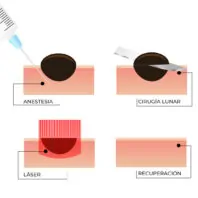
In general, the best time is in winter, as the sun can darken the wound. If you indeed have a mole, removing them with a CO2 laser or by shaving are very good options. And the healing will depend on many factors that you will need to discuss during your consultation with your dermatologist.
Best regards
Hello, I have a raised mole between my eyebrows, I was wondering if it can be removed, and if it will leave a scar. Should I go to the dermatologist?
Hi Maria,
When answering your questions, it is always recommended that you consult a dermatologist to evaluate the lesion you want to remove. In our consultation, we will assess the diagnosis and your skin type, and based on this, we will determine the optimal treatment for its removal and the risk of scarring.
Best regards
Hi, I have a mole on my cheek a few centimeters from my nose; it's about a centimeter in size. I've had it for as long as I can remember, and it hasn't caused me any pain or discomfort to date. It just seems a bit unsightly to me. I'd like to know the cost to remove it, please.
Dear Mariana,
To assess whether it can be removed, I need to see you in person. The price varies slightly depending on whether a microscopic study of the mole is necessary and the technique used for its removal. You can find out more calling the clinic where I work.
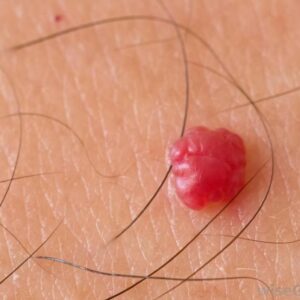
Yesterday I decided to cut off something that looks like what's called an angioma in the photos you published in your article... after I cut it, I applied a cotton ball with alcohol and tape, and after all night, this morning it was still bleeding when I removed the bandage... but after a while of letting it bleed, it stopped... Now that I've read your article, I'll look into going to a dermatologist tomorrow, lol, because I have another smaller one next to the one I cut off, and I have some more in other parts of my body.
Hello Gregory,
Yes, the problem with removing them that way is that there's no way to stop the bleeding afterward, and we also won't know the diagnosis. I'm glad you've decided to go to the dermatologist so they can evaluate them and give you the correct treatment. If you want to know more about the topic, I wrote a article dedicated to hemangiomas.
Best regards
Hello, I would like to know what procedure I can follow to remove a mole that has appeared on my forehead between my eyebrows for some time now. A few days ago I went to the dermatologist to address this issue, and they didn't give it much importance, saying that I could end up with a scar on my face. I also went to remove a small wart I had, and they removed it using cryotherapy. I still have the wart and I don't know if this is normal or if I'm not healing it properly. I am also concerned about the possibility of a scar, as I have seen that it is not a very aesthetically pleasing method.
Hello Patricia,
Regarding the mole on your forehead, it will surely be benign, and the only reason to remove it would be for cosmetic purposes. To assess the risk of scarring and how it will look, we need to see the mole. This will allow us to evaluate if it can be removed safely.
As for warts, cryotherapy is an effective method for removing them; however, we often cannot be 100% sure whether they will be completely removed. In these cases, it’s best to follow up with your dermatologist for a repeat treatment session. In my daily clinical practice, I prefer to remove them with a laser or electrosurgical unit because I have better control over the depth, and I can tell right then and there during the appointment whether they’ll be completely removed.
Greetings
Hi, I have a mole on the left side of my nose, in the middle, and I'd like to have it removed.
But I don't know if there will be consequences if I remove it.
I await your response
Thank you
Hi Crystal,
To determine treatment options and the possibility of scarring, it is always essential to assess the mole in person. Depending on the type of mole or other skin lesion, it will be possible to establish whether it can be removed and what potential complications/consequences there may be.
Best regards
I just had a mole removed by cauterization. It's been 2 months, but a little spot has reappeared. Can the mole grow back in the same place?
Dear Alex. If a mole has been removed by cauterization, the «roots» of the mole always remain in the skin. It can happen that it repigments and has an unusual brown to black color. Or, it can also happen that it grows back outwards like a wart.
As I always say, one of the most important things is to have a good diagnosis of the lesions before removing them, and especially when burning them with a method like cauterization. Any doubts regarding your treatment should be discussed with your dermatologist.
Best regards
I have a mole on the side of my nose that looks like a wart, and I'd like to remove it, but because of my young age, I don't know if it can be done.
Hello Estrella,
When we remove a mole for aesthetic reasons, we always consider its characteristics to offer the best treatment. Age is not normally a limiting factor in these procedures. If the specialist who evaluates you believes it is easy to remove and can do so without problems despite your age.
Best regards
Excellent article, Doctor.
Tomorrow I'm going to the dermatologist. I've had what looks like a skin tag on my back for a week, but I'm starting to worry because I've noticed it's irritated and has been bleeding a lot the last few days.
Your article has helped me to see the bigger picture better and not get too scared anymore. Grateful once again.
Hello Daniel,
I'm very glad the article helped you. It's always important to see a dermatologist when lesions change or become irritated, but the most frequent diagnoses are usually benign. So you're doing perfectly, and it's always best to have it checked by a specialist.
Best regards
Hello Doctor, I would like to ask you a question. I had a mole removed using the cauterization method. Two days have passed, and I realized it wasn't completely removed. What are the risks? Can it be treated again?
Hola Silvia,
First of all, it would be good to know if what was removed is indeed a melanocytic nevus. If so, it is always recommended to have a microscopic study of it to be sure of the correct diagnosis. Without a diagnosis of the lesion, I cannot comment much further, but usually, reoperation is possible.
I have a mole near my anus, it's protruding.
I would like it removed, but because it's close to the anus, I'm afraid of it getting infected.
Hi Manuel,
In principle, there are no problems with performing a procedure in this area. Your doctor should provide you with guidelines for specific aftercare to prevent infection.