We use technologies like cookies to store and/or access device information. We do this to improve your browsing experience and to show (non-)personalized ads. Accepting these technologies will allow us to process data such as your browsing behavior or unique IDs on this site. Not accepting or withdrawing consent may negatively affect certain features and functions.
The technical storage or access is strictly necessary for the legitimate purpose of enabling the use of a specific service explicitly requested by the subscriber or user, or for the sole purpose of carrying out the transmission of a communication over an electronic communications network.
Technical storage or access is necessary for the legitimate purpose of storing preferences not requested by the subscriber or user.
The technical storage or access that is used exclusively for statistical purposes.
Technical storage or access used exclusively for anonymous statistical purposes. Without a subpoena, voluntary compliance from your Internet Service Provider, or additional records from a third party, information stored or retrieved for this purpose alone cannot usually be used to identify you.
The technical storage or access is required to create user profiles to send advertising, or to track the user on a website or across several websites for similar marketing purposes.





353 Responses
Hello, good morning. I have a question.
Yes, if you remove a mole with a CO2 laser, it's possible for it to grow back.
Hi Juan,
If you remove a mole with a laser, the mole's roots typically remain deeper down. In rare cases, the mole might grow back a little, but not to the extent it was before. In these situations, the procedure can be repeated without any issues.
Best regards
Thank you very much
Good morning, excuse
Hello,
It may be possible to do so, but it's always important to discuss it with a dermatologist or surgeon to assess the aesthetic outcome that can be achieved. We must remember that we will be replacing a mole with a scar, and depending on the location, the pros and cons need to be weighed. Best regards.
My daughter is 10 years old and her birthmark covers the first third of the bridge of my index finger on her face (between her eye and the bridge of her nose). She's been under dermatological observation since she was one year old and it hasn't changed much. They tell me she would have cosmetic surgery to remove it, but it's highly likely it would grow back.
Hello again,
I would love to give you my opinion on your daughter's case, but it's very difficult for me to do so without seeing her in person. Normally, when a mole is completely removed, it shouldn't reappear.
Best regards
Hello! I have a mole that.
I would like to know if you could remove it (it's where my left eyebrow begins)?
Thank you for your attention.
Warm regards.
Dear Javier,
Given the size you describe, removing this mole shouldn't be a problem. As I've explained in this post, before removing any mole, a proper study of it with dermatoscopy is necessary to establish a diagnosis. Afterward, we will choose the best method to remove it. Best regards.
Do you have a clinic in Mexico City and what is the location so I can start a diagnosis for my mole?
Thanks for your attention
Greetings
Dear Javier. I only work in Barcelona, Spain.
Hello Doctor, Good Morning, I would like to have a mole removed with an incision. Is it true that the mole will be removed from the root, will it leave a scar, and will the mole no longer grow back in the extracted area?.
Dear Fernando,
There are many different ways to remove a mole.
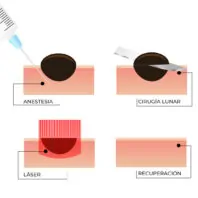
When they are raised, we have the option to shave them down to skin level through a procedure called «shave excision.» In this first case, the roots remain, and there is a small possibility of regrowth, but the advantage is that no stitches are used, and it is more aesthetically pleasing.
Secondly, there is an excision (incision), which is what I imagine you're asking about. In this case, the mole is removed deeply, creating a wound that requires stitches. The advantage is that we remove the entire mole, but we have to put in stitches, which is usually less aesthetic.
Best regards
Good morning, I went to the dermatologist and she told me that she hadn't detected any problems with the moles I wanted removed, but that she couldn't guarantee they wouldn't become malignant moles in the future. So she recommended removing the moles with surgery instead of laser.
What I don't understand is, if I have moles removed surgically, should I keep the removed samples myself? And for how long? Until the removed mole becomes malignant? Or are they sent to a laboratory and do I have to pay a fee every X amount of time to keep them there?
Thank you very much, and I apologize for any inconvenience.
Hi April,
We ourselves send the moles we remove for analysis in the laboratories, and they are responsible for preparing a report and storing the samples. Therefore, you will not have to worry about this particular matter.
Best regards
Good evening, I hope you're doing well. I'm writing to you again with a question. I went to a clinic to have my moles removed with a laser (at first I wanted to have them removed surgically, but the doctor told me it would leave a scar and that they had a high-end laser—one that only five clinics in Mallorca had—and I don’t know what else), After the laser session, the doctor told me I would have to take pills called “Dermovance M” for 3 months to prevent the moles from becoming pigmented again. But the problem is that after two weeks, it looks like the moles are coming back, so I’ll make an appointment for a follow-up.
My doubt is whether “Dermovance M” really works or if it's a scam for.
Hello Doctor, blessings to you and your family. A mole appeared under my left breast, but it has been growing and it hurts. I am going to the dermatologist, and God willing, it doesn't come out with malignant characteristics. What procedure should be done to remove it? And is there a risk it will develop faster with removal? What do you suggest?
Hello Miredys,
I hope you are doing very well. As you say, the most important thing is that you first see a dermatologist to properly evaluate this mole and they can tell you what it is. Once we have the diagnosis, we can better explain whether it needs to be removed, the procedure, and its risks.
Hello Doctor... I have a skin tag on my head and every time I go to the hairdresser, they pull it off, but not completely. It's like a little blood sac that has formed... I need to get it removed because I cut it myself or the hairdresser does... What do you suggest? Thank you
Hello Natalia,
Just as you say, the recommendation would be to remove this «flesh mole» by a dermatologist and analyze it under a microscope. My The practice is located in Barcelona, Spain if you happen to be nearby.
Best regards
Good morning, next week my daughter is going to have a mole removed from her head. She's had it since birth, and at first it was a small mole, but it has become like a wart. The dermatologists told us it was all normal and that they would remove it if it bothered her, and honestly, it's bothering her more and more when she combs her hair, and it's visible when she ties her hair back. They told us it's like pulling a tooth, but that they have to do it from the root with a scalpel, outpatient surgery with local anesthesia. We are a bit scared. We don't know how anesthesia works on the head, if the surgery will require stitches, and if her hair will grow back in the area. Thank you very much.
Dear Marco Antonio,
As you explain well in your message, it is surely a benign lesion and the reason for removing it is the discomfort it causes.
Regarding the anesthesia, it's quite simple as it's placed just under the skin.
Since it's a congenital mole (from birth), they will surely remove it through surgery with stitches. If it's small, only a small scar will remain, which will be perfectly hidden among the hair.
Best regards
Hello. I had three moles removed from my face, I think it was with a laser or radiofrequency (something), the point is that they didn't put those protective glasses on my eyes and I don't know if that can affect my vision. HELP PLEASE.
Hello Monica,
If you haven't been given protective glasses, it's likely because it was removed through electrofulguration or a similar technique. When we use lasers, we do use eye protection. It's best to ask directly at the center where you had the treatment done.
Best regards
Hello, my father's mole on his left cheek is getting worse and worse, so much so that the skin has opened up. Horrible!
I would like to know how to treat it.
Hello Rudis,
Without a doubt, what you need to do is go in person to a dermatologist so they can evaluate this lesion live and make a correct diagnosis.
Hello, I'm from Virginia, I'm interested
I have a 1-year-old baby diagnosed with a giant congenital melanocytic nevus located on her cheek. What is the recommended age for lesion removal, what technique is considered ideal from an aesthetic perspective, and which specialist is most recommended (plastic surgeon, dermatologist, pediatric surgeon)?
Hi Nayely,
Based on what you've told me, it's likely not a giant congenital nevus, but rather a medium congenital nevus if it only affects one cheek. Dermatologists classify congenital nevi (birthmarks) into small, medium, large, and giant depending on size that they have at birth. In the case of small and medium moles, the future risk of developing melanoma It is not bigger that of any other mole on our body, so removing it would only be indicated for aesthetic reasons.
Nowadays, removing congenital nevi of this type is largely a parental decision that should be evaluated alongside specialists. If a good aesthetic result can be achieved, it might be advisable to remove it. In many countries around the world, these moles are not removed, while in others, their removal is encouraged for aesthetic reasons. In Spain, there is an association of congenital giant nevus where you can read patient testimonials and learn a bit more about the topic.
Regarding the best specialist, I think it depends more on each person's expertise and the country you are in.
Warmest regards, and I hope I've answered some questions.
The doctor consulted me about having a mole removed on my shoulder. The dermatologist referred me to plastic surgery. The plastic surgeon indicated that there are two ways to perform the procedure: in the operating room or in the office.
I chose a topical anesthetic, but I'm regretting it because I'm nervous. The doctor told me she'll make a large incision to remove everything, then stitch the tissue and then the skin.
What do you recommend? Change the procedure and do it in the operating room?
Hi Jessica,
Largely, the choice of whether to perform surgery with local or general anesthesia will depend on the size of the lesion to be removed. Typically, small/medium moles < 4 cm can be perfectly
Good morning, Doctor. I live in Madrid and I saw that you are in Barcelona. What a shame!!!
A few months ago, I had some moles removed with a laser, and honestly, the marks they left are very noticeable. They're red, as if they were burned. When I asked, the doctor told me it was normal because I have a darker complexion and that's just how it is. His answer surprised me because when I was younger, I also had moles removed, and it's true that a small scar was left, but it was almost unnoticeable because it was the color of my skin and blended in very well. On that occasion, they cauterized the moles, and the result was excellent.
I read in your post that laser treatment yields better results, but that wasn't the case for me;
Thank you very much for your response.
Greetings
Hi Lola,
I hope you are doing very well. Although I can't give much of an opinion without seeing you in person, it's normal for the red marks to gradually disappear over the course of a few months. Laser is a very good method for removing moles because it is very precise, but there are also other methods like cauterization, which you mentioned. It's also true that during childhood, marks/scars tend to heal much better than in adulthood, and this may be the reason why they are taking longer to heal now.
For now, it's very important that you protect yourself very well from the sun with a broad-spectrum sunscreen and apply a good scar cream.
Best regards
Hi, I would like to inquire about the price. I have a mole on my forehead that appeared when I was 13 years old. From what I've seen on pages, I think it might be melanoma.
Hello Milagros,
Based on what you're telling me, it would be very unusual for you to have melanoma, as it's quite rare in childhood and it.
Greetings
The dermatologist diagnosed me with seborrheic keratosis and I intend to have the laser procedure. Is it appropriate?
Hello Lorena,
Yes, seborrheic keratoses can be removed in many ways, and CO2 laser is a very good option.
Best regards