
Moles, also called nevi, can appear on the skin in different shapes, sizes and colors. A very characteristic type is the blue nevus or blue mole which is named for its characteristic color.
Although these types of moles are not frequent, are usually benign and are not a cause for concern. However, as in any other it is important to monitor the mole to see if it changes shape or size over time..
Keep reading this article to learn more about these moles and the research studies we are conducting to learn more about them.

What is a blue nevus?
A blue mole is made up of the same cells as the rest of the moles, the melanocytes.
Interestingly, the blue color is due to the pigment being deeper in the skin than ordinary moles and not because it is actually blue. This physical characteristic is called the Tyndall effect and is responsible for the blue color of these moles.

Because the pigment is relatively deep, it is susceptible to the Tyndall effect. That is, there is selective absorption of the longer wavelengths of light by the deep dermal pigment, with reflection from the skin to the eye of the shorter (blue) wavelengths.
What do blue polka dots look like?
Blue nevus has a characteristic blue-blackish color and usually presents as a single lesion of 0.5 to 2 cm anywhere on the body.
Here are some images so you can see what these blue polka dots look like.
Clinical imaging


Dermatoscopic images


Why does a blue mole form?
Most blue nevi appear during the first four decades of life and are rarely present at birth. For reasons that are unclear, women are more likely than men to develop a blue nevus.
Due to the variation in the frequency of blue nevi in different populations, a genetic predisposition has been suggested. However, familial cases of blue moles are extremely rare.
Is a blue mole dangerous?
A blue nevus is not dangerous at all and you can have a benign blue nevus on your skin for your entire life. However, on some occasions there may be malignant lesions that can simulate a blue mole.. That is why in some situations, which I will discuss below, it is advisable to see a dermatologist to check this type of mole.

In summary, blue moles that develop and begin to grow in adulthood may be cause for concern. If you get a blue nevus or other mole after the age of 30 it is best to have it checked out in the office. It may be a sign of skin cancer such as melanoma.
In addition, we have seen that blue moles are very stable over time and changes or growth is rare. Therefore, if we observe changes in blue nevi, it would be advisable to see a dermatologist to check them.
All of the following characteristics of blue nevi are sufficient reason to request an appointment with a specialist to rule out malignancy:
- It has an asymmetrical shape
- Has irregular edges
- Change color over time
- Grow in size or are larger than 6 millimeters
- Protrude from the skin
- Are annoying, painful, itchy or bleeding
If you notice any of these changes, go to your dermatologist to evaluate you.
Is it necessary to remove a blue nevus?
Blue moles are benign lesions and are it is not necessary to remove them if the diagnosis is clear.
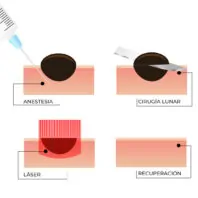
If there is doubts about the diagnosis, a complete excision may be considered. of the entire lesion. The melanocytes of a blue nevus are usually quite deep and a superficial biopsy by shaving or attempting to remove them by laser is not possible.
You can also talk to your dermatologist about the removal if the mole is causing you discomfort. For example, if it rubs against your skin or causes other types of irritation.
If the blue nevus reappears after removal, contact your dermatologist. It could be a sign of skin cancer.
Blue nevus research
Together with our research team of the Hospital Clínic de Barcelona we developed the first cohort study to assess the change in the growth of blue moles.
For this purpose, we used image databases of more than 22 years and, by means of artificial intelligence tools, we were able to achieve identify blue nevi among more than 1,000,000 images. Thanks to the intensive follow-up we performed on our patients on a regular basis, we were able to measure the change in size of blue moles over many years. Finally, we were able to plot and explain how this peculiar type of mole behaves.

As a conclusion of the study, we could observe that most of the blue nevi are very stable over time and their size does not change (blue lines). In some less frequent cases, we observed a discrete growth of less than 100%. Only in 2 cases did we see a very rapid growth that required excision of the lesion. to rule out a malignant mole and in these cases we are studying the molecular biology of these tumors.
Blue mole - my findings
Blue polka dots are benign skin lesions and usually appear during the first decades of life.
But if the mole appears later in life (after the age of 30), or if a previous blue mole starts to gradually change over time, you must see your dermatologist to rule out malignancy.
If we decide to remove the mole we will always perform a histological study. This way we can verify the diagnosis, and in the rare case that it is malignant, we can advise you on the steps to follow.





49 Responses
A while ago, a blue mole appeared on the side of my vulva, lower down. It grew a bit, and then another one appeared on the other side. I'm 69 years old. They're going to remove them. Is that the best option?
Hello Laura, if you have a mole that has grown or changed, it's important for a dermatologist to examine it before deciding to remove it. This will ensure that the appropriate measures are taken for your health. A specialized examination is best.
Hello,
I wanted to comment on what I have on my foot, I am currently 52 years old, but around the age of 10 years in a river I hit a rock, I got a bruise and this became a blue spot that never went away. Of all the dermatologists I have seen for other reasons and who have seen this spot, only one told me that this was a natural tattoo, the others never knew how to explain what it is. The dermatologist who told me what it was, pointed out that I can remove it with laser, but that he thinks it is better to do nothing. I would like to know if it is also considered a blue nevus.
Greetings.
Hi gloria, it is very difficult to give an opinion about your case without knowing you and evaluating the injury. It is probably a traumatic tattoo from what you say.
Hello I got a few years ago as a black spot on my arm and a few times ago something grew and I went to the dermatologist to do a biopsy as q I have 49 years gave as results blue nevis and also says incisional resection, he wants to see me in 2 months is normal or do I have to worry ?
Hello Andrea,
If the result is blue nevus you have to be very calm because it is a benign diagnosis.
Hello I find the report very interesting I just wanted to add that I have a blue mole on my shoulder since birth and never grew always stays the same and the only history I have is that of my maternal grandmother who also had.
Best regards
Hello Annia,
Indeed, what you tell us is the most normal evolution of a blue mole. Best regards and thank you for sharing your experience
Hi Doc, I have a blue or dark mole between my little toe. I have never seen it before and I don't know how long I have it. I am 36 years old and reading this worries me, although I have no pain, itching and it is not deformed. Would it be better to evaluate it? Thank you.
Indeed Pau, whenever we have a change in a mole it is best to have it evaluated by a specialist.
Hello good evening, excuse me, my daughter has a blue mole since she was born in the lower part of her back, almost reaching her buttocks and it is there in a greenish blue color; she has always had that color, is it normal? She is now 13 years old and has had it since she was born.
Hello Renata. I understand your concern. It's probably nothing major since he's had it since birth and it will most likely be a benign condition. However, if you don't know the diagnosis and have never seen him, it never hurts to visit the dermatologist sometime for a routine checkup.
Best regards
[spoiler title="I have one on my buttock, it's a little big, thanks for the information I was worried about it, thank you".
Me too
Hello on a mole that I have always now rn one side is like blue although I have already seen a good dermatologist and has told me that it may be a vein and that everything is fine I'm worried.
Hi, I got a blue mole...to me it's like a black spot but blue in color. My sister and I thought it was a black dot and tried to remove it with her fingers but it bled, now it's crusted over a little and it's red all around. should I be worried or is it normal.
Aly, without seeing this mole in person it is impossible to comment. The important thing is to have it assessed by a specialist.